Where it leaks, what it means, and who fixes it
Watch the faucet for a minute with the hose off, then again with the hose on and the handle open.
| Where the water shows | Likely cause | Fix | DIY? |
|---|---|---|---|
| Around the handle stem | Loose packing nut or worn packing | Tighten, then replace packing if needed | Yes |
| Drip from the spout, handle closed | Worn seat washer or damaged seat | Replace washer, or repair or replace faucet | Yes |
| Spray from the vacuum breaker cap | Normal breather action or a failed breaker | Remove the hose, replace the breaker | Yes |
| Water at the wall behind the faucet | Cracked stem or failed joint | Shut off, then repair or replace the faucet | Call |
| Wet siding, soft sill, or stain inside the wall | A leak in the supply line after the freeze | Locate and repair the line | Call |
| Nothing leaks until the hose is on | Frost damage inside the stem or pipe | Replace the frost-free stem or the faucet | Call |
If the wall or ceiling inside is damp, stop testing and shut off the water.
The packing nut fix, step by step
- 1
Shut off the supply.
Close the interior valve, then open the outdoor faucet to drain the line and relieve pressure.
- 2
Snug the packing nut.
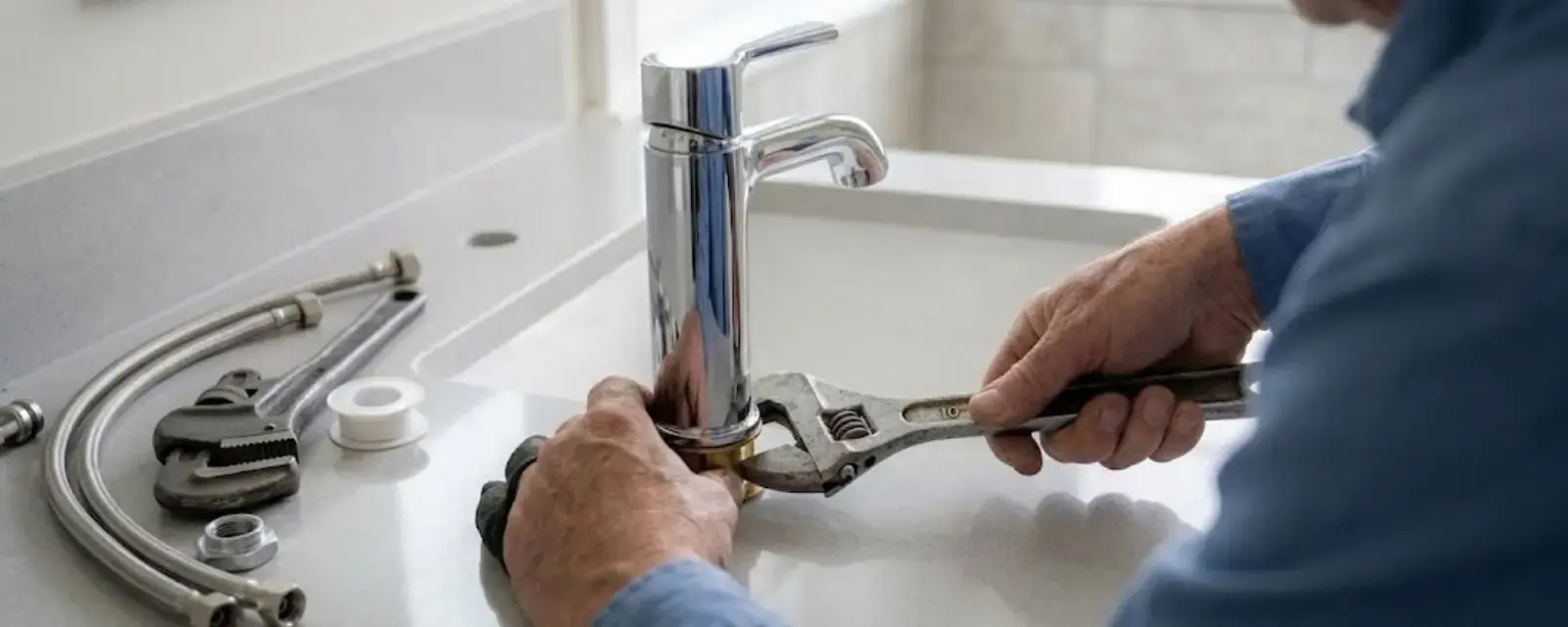
Use a wrench to tighten the nut behind the handle a quarter turn at a time. Stop when the leak stops.
- 3
Replace the packing if tightening fails.
Remove the handle screw, handle, and nut, then wrap graphite packing string or replace the packing washer and reassemble.
- 4
Test with the water slowly on.
Turn the supply back on slowly, open the faucet, and check the stem and spout for drips before you leave.
Frost-free spigot basics
A frost-free sillcock puts the shutoff valve seat deep inside the warm part of the wall, on the end of a long stem. When you close the handle, the valve shuts inside the house, and the water in the outer barrel drains out. That only works if the faucet is mounted with a slight downward tilt and the hose is removed.
Leaving a hose connected traps water in the barrel, and it can freeze and split the tube. The split often stays hidden until spring, when you turn the faucet on and water sprays inside the wall instead of out of the spout. A hose-end shutoff or a splitter that holds the hose in place can cause the same problem.
Before you take anything apart
Shut off the water first, and keep your hands out of any wet area where an electrical outlet or an extension cord is nearby. Do not force a seized handle. If a screw spins, a stem is stuck, or the valve will not shut, stop and call, because forcing it can turn a drip into a pipe break.
A checklist for the first warm day of spring
A faucet that sat through winter should be tested before the hose goes back on.
- Open the faucet slowly.
Turn on the interior valve and watch the wall and the basement ceiling below for dampness.
- Look at the stem.
A spray from the packing nut area is a quick fix. A spray from the pipe behind the faucet is a stop and call.
- Check the water meter.
With every fixture off, a moving meter dial points to a hidden leak somewhere in the house.
- Photograph damage.
Take pictures of any wet wall or ceiling for your insurance conversation.
- Note the age of the faucet.
A very old unit with corroded threads is usually cheaper to replace than to chase.
Wildwood winters and outdoor taps: what to know locally
St. Louis Public Radio reported a wind chill of minus 33 degrees Fahrenheit across the region on the night of December 22, 2022, and 4 degrees with a minus 17 degree wind chill at 3:30 p.m. on December 23. That article did not mention pipe damage, so we cannot say how many Wildwood faucets froze. It does show how fast a mild week can turn, and anything with trapped water outdoors is at risk.
In January 2025 the City of Wildwood posted that frozen pipes and related problems become more common as colder temperatures set in, and it listed two Missouri American Water main breaks in the Lake Chesterfield area and Chesterfield Valley. The city did not link those breaks to freezing. The practical point is to disconnect hoses and close indoor shutoff valves before the first hard freeze.
The City of Wildwood's building permits page lists minor repairs among work that does not need a building permit. Replacing a washer or packing is minor, while cutting into a wall to replace a supply line is not, so ask the building department before you do that kind of work.
Sources: St. Louis Public Radio December 2022 report, City of Wildwood January 2025 news post, City of Wildwood building permits page
Winter prep that prevents the spring leak
Before the first hard freeze, remove every hose, splitter, and nozzle. Close the interior shutoff valve to each outdoor faucet and open the outdoor handle to drain the line. If a faucet has no interior shutoff, ask a plumber about adding one.
Older standard spigots without frost-free stems are the highest risk. Replacing one with a frost-free model before winter is cheaper than repairing a burst behind the wall. Faucet covers help on cold nights, but they do not replace draining the line.
Where a plumber helps
Our faucet repair team replaces stems, washers, and whole sillcocks, and our burst pipe repair crews handle the damage behind a failed fitting. If water is spraying inside, shut the main valve and call our 24/7 line for a same-day visit when available.
Homes in Chesterfield near Lake Chesterfield and in Eureka near the Meramec River see these calls too, and the steps are the same everywhere.
Outdoor faucet spraying or wet behind the wall?
Close the main valve and call for a same-day visit when available.
Questions we hear in Wildwood, MO
The packing nut is loose or the packing is worn. Close the supply, tighten the nut a quarter turn, and retest. Replace the packing if tightening does not stop it.
The seat washer inside is worn or the seat is damaged. Replace the washer, or replace the faucet if the seat is pitted. If water also appears inside the wall, call a plumber.
You can replace the washer or a packing nut. A frost-split stem or a leak behind the wall needs a plumber, since the damage may be hidden. Shut the interior valve if you find water on the inside.
St. Louis Public Radio reported a minus 33 degree wind chill on the night of December 22, 2022, and a 4 degree reading with a minus 17 degree wind chill at 3:30 p.m. on December 23. The report did not describe pipe damage, so we do not claim any. Use the event as a reminder to drain outdoor lines before hard freezes.
The city's permits page lists minor repairs as work that does not need a building permit, but cutting into walls or replacing supply lines is a different job. Permit rules vary, so ask the building department when you are unsure.
Close the main valve, keep people away from wet outlets, and call a plumber. Take photos of the damage for your insurance conversation. Your policy decides what is covered.
A small spurt from the breaker cap when the water first turns on can be normal. A steady stream while the hose is running points to a failed breaker. Replace the breaker or call us if it keeps happening.
Have a question this page did not answer? Call (855) 575-2890 at any hour and a dispatcher will talk it through.