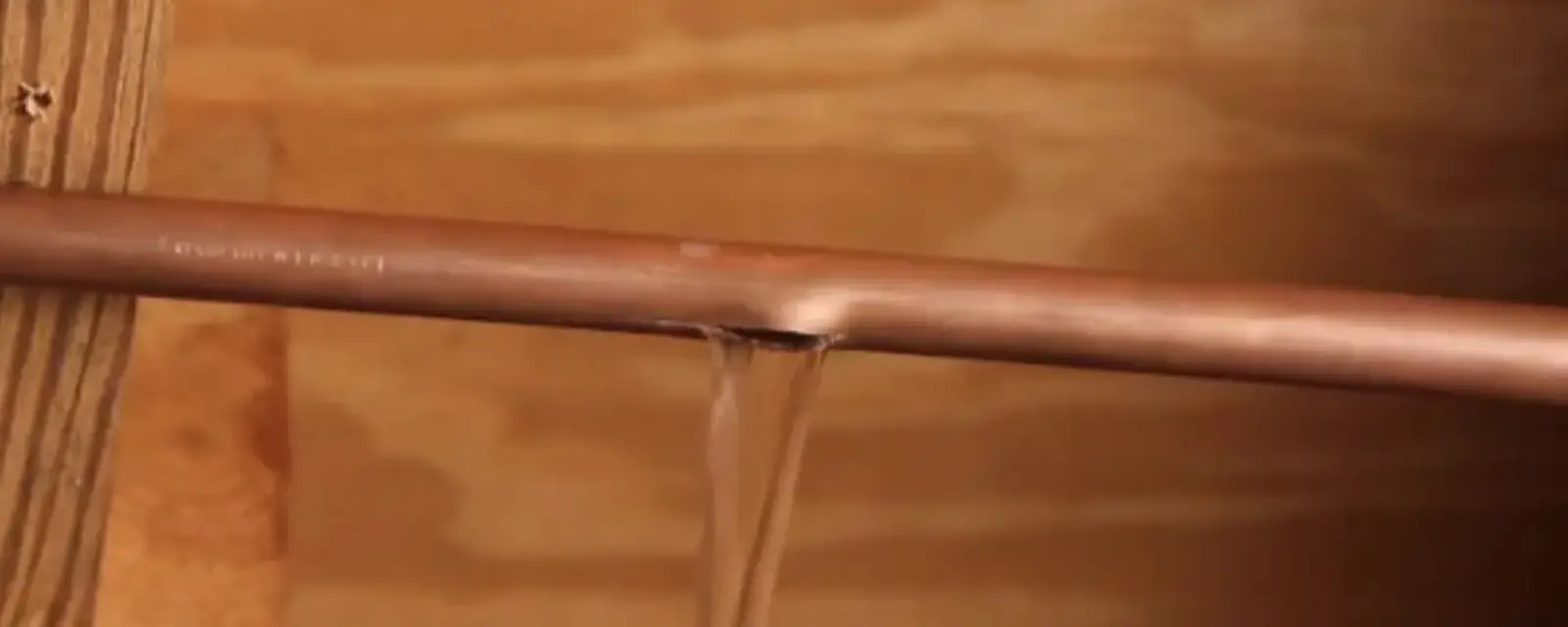
A burst pipe is an emergency: the first ten minutes
Do these in order while you wait for a plumber, and stop if anything feels unsafe.
- Close the main valve.
Turn the main shutoff clockwise until it stops. It often sits where the line enters the house, and the shutoff at the outdoor meter is a backup.
- Open the lowest faucet.
Draining the lines lets standing water leave through the tap and not through the break.
- Turn off the water heater.
Switch off the gas control or the breaker so the tank is not heating with water trapped inside.
- Stay clear of wet electricity.
If water is near outlets, a panel or a basement ceiling light, do not step into it. Shut off power only if you can reach the breaker while dry.
- Move belongings and take photos.
Lift rugs, boxes and electronics off the floor, then photograph the damage and the break for insurance or a landlord.
- Smell gas? Leave first.
If you smell gas, leave the building and call the gas utility's emergency line or 911 before calling a plumber.
Frozen pipes and Wildwood cold snaps
Pipes burst when ice forms inside them and builds pressure between the ice plug and a closed tap. The pipe usually fails at a weak spot, not at the ice itself.
The December 2022 cold snap that pushed wind chills far below zero is a recent reminder. St. Louis Public Radio reported a minus 33 degree wind chill that Thursday night. Wind chill measures how cold exposed skin feels, not the temperature of a pipe, but wind does push cold air through gaps at rim joists, vents and garage doors.
The city posted in January 2025 that frozen pipes and other water line problems become more common as temperatures fall, and it listed Missouri American Water main breaks on streets near Lake Chesterfield. Those breaks were in the utility's mains, not house plumbing. If your water stops in cold weather, check your own exposed pipes first, then ask the utility whether there is a street-level problem.
Likely freeze spots are pipes in exterior walls, garages, crawlspaces, uninsulated basement corners and outdoor hose bibs. To thaw a frozen pipe, open the tap, warm the pipe slowly with a hair dryer or warm towels, and never use a torch. If a pipe is already split, thawing releases water, so be at the main valve first.
Keep cabinet doors open on cold nights, let a tap drip on exterior-wall lines, and disconnect hoses from outdoor faucets before the first hard freeze.
Water running right now?
Close the main, then call. We dispatch around the clock, and same-day visits are available when schedules allow.
Copper, PEX and PVC: how each fails and how we fix it
The pipe material decides the repair method and how long the fix takes.
| Pipe | How it usually fails | Typical repair |
|---|---|---|
| Copper | Freeze splits, pinholes, failed solder joints | Cut out the section, add new copper with press or soldered fittings |
| PEX | Fitting leaks, UV damage, freeze bulges | Replace the fitting or the section with a PEX coupling |
| PVC | Cracks from impact, age or ground movement | Cut out the crack and cement in a new section |
| CPVC | Brittle cracks near fittings | Replace the damaged run, since cracks tend to repeat |
| Galvanized steel | Rust-through and leaking threads | Splice a short piece or replace a longer run |
PVC and CPVC are used for different jobs, and we match the fix to the original pipe type.
Copper, PEX and PVC repair, pipe by pipe
Copper pipe repair
A frozen copper line usually splits along a seam, and a worn one fails as a pinhole. We cut back to clean, round copper, remove the damaged length and join new pipe with soldered or press fittings. A repair clamp can stop a leak in a pinch, but it is a patch, not a fix.
PEX pipe repair
PEX is flexible and tolerates more expansion than copper, yet it can still split, and fittings are its weak point. We replace the failed section with a PEX coupling or a new fitting and check the neighboring joints, because one bad crimp often hints at more.
PVC pipe repair
PVC carries cold water, drains and irrigation. It breaks when struck, stressed or left to freeze while full. We cut out the cracked piece, fit a coupling with solvent cement and let it cure before the line is pressurized again. Hot water lines need a different material.
Cracked or leaking pipes that have not burst yet
Not every failure is a gusher. A hairline crack, a weeping joint or a pinhole can drip for weeks and stain a subfloor before anyone looks. A mineral crust on copper, a damp joist below a bathroom and a wet spot that returns after wiping are signs worth a call.
A short repair on a sound pipe is practical. A pipe with several leaks, thin walls or corrosion near fittings is a candidate for replacing the whole run. We show you the old section and explain which situation you have, because patching a failing pipe tends to move the leak down the line.
If the source is not visible, a leak detection visit finds the spot before anyone cuts anything.
Cracked drain pipes
Drain pipe damage looks different from supply damage. You may see sewage-smelling dampness, slow drains in one part of the house, or a stain that appears after the washer discharges. We camera the line to see the crack, then replace the damaged section with matching pipe and the right fittings.
If roots or settling are involved, the repair may run into the sewer line repair scope.
What happens during a burst pipe visit
- 1
Stop the water.
We confirm the main is closed, drain the lines and check that no live water is feeding the break.
- 2
Find the full extent.
We inspect beyond the visible break for stress, bulges or a second split, since freezing rarely damages one spot only.
- 3
Cut and replace.
The failed section comes out, and new pipe goes in with fittings that suit the material and the code.
- 4
Pressure test.
We open the water slowly, test for leaks and watch the joints under pressure.
- 5
Dry-out guidance.
We tell you what to open, what to photograph and when to bring in a water extraction crew.
Documenting damage for insurance or a landlord
Take wide and close-up photos before anything is moved, note the date and time you shut off the water, and keep the broken pipe section if we remove it. Save every receipt for repairs and drying equipment.
Renters should tell the landlord or property manager right away, in writing if possible. Your policy decides what is covered, and an adjuster will want the timeline and the pipe.
What affects the price of burst pipe repair
Two burst pipes can look alike and cost very different amounts. You get a clear price before work starts.
Copper and larger lines cost more to fit than short PEX or PVC runs.
A split in an open basement ceiling is faster than one behind finished drywall or in a tight crawlspace.
A single pinhole is a short repair, while a freeze that damaged several feet or multiple spots is not.
After-hours emergency work involves night dispatch, which can price differently from a scheduled visit.
Opening a wall may need patching, and drying or restoration is a separate trade.
Sudden burst damage, such as a freeze split that floods a room, is often covered by homeowners insurance. Wear, corrosion and long-term leaks often are not, and some policies exclude vacant homes. Your policy decides, so call your agent early.
For a real number on your repair, call our 24/7 line and tell us the pipe type and where it split.
When the bigger fix is a new line
If the break is on the buried line from the street, see our page on water line repair. If your home has repeated failures on aging supply pipe, a repiping evaluation may be a better use of money than another patch. Neighbors in Ellisville call us for the same freeze and burst problems.
Questions we hear in Wildwood, MO
Yes. Dispatch runs 24/7, including nights, weekends and holidays, and same-day appointments are offered when available. Close the main valve first, open a low faucet, and keep away from wet electrical areas until a plumber arrives.
In basement homes it is usually near where the line enters through the foundation, often by the water heater or the meter. In crawlspace homes, check the front wall or a utility room. If you cannot find it, the shutoff at the meter outside is the backup.
Sometimes. Open the tap, warm the pipe gently with a hair dryer or warm towels, and never use a flame. If the pipe may already be split, be ready at the main valve before it thaws. Call us if you cannot reach the frozen section.
Often when it is sudden and accidental, such as a freeze split that floods a room. Gradual leaks, corrosion and wear are often excluded. Your policy decides, so photograph everything and call your insurer.
Condensation forms on cold pipes in humid air and appears evenly along the pipe. A crack leaves a drip point, mineral crust or a stain that grows. If you wipe it and it returns at one spot, call for an inspection.
Leave the building at once and call Spire's 24/7 emergency line or 911 from a safe distance. Do not use switches, garage door openers or alarms inside. Call a plumber after the gas utility says the home is safe.
Have a question this page did not answer? Call (855) 575-2890 at any hour and a dispatcher will talk it through.