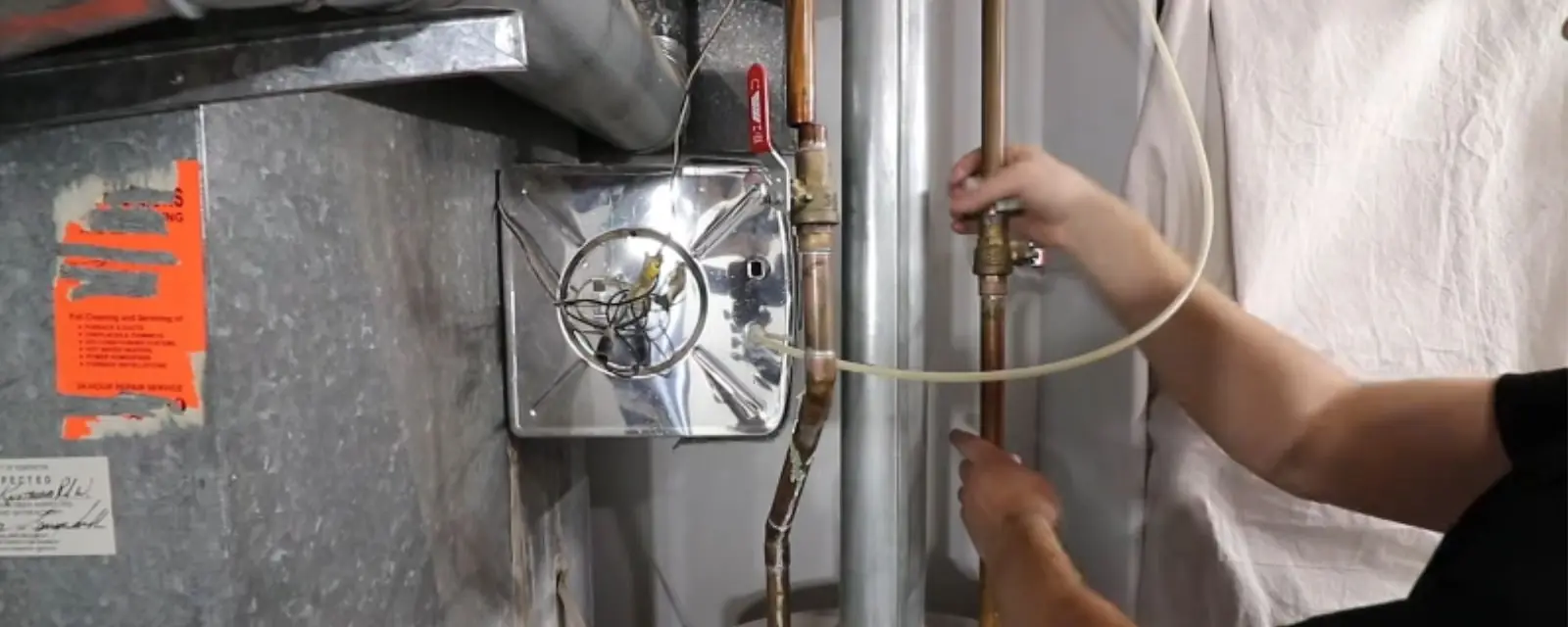
When a leaking water heater is an emergency
A drip from a pipe fitting is a repair. Water coming from the bottom of the tank jacket is usually a different story, because it points to a hole in the steel liner and no part swap fixes that. Either way, a full 40 or 50 gallon tank can empty onto a basement floor in under an hour if a fitting lets go, so treat any steady leak as urgent.
Close the cold water supply valve above the heater first. Then cut power at the breaker or turn the gas control off. If the floor around the unit is wet, stay off it until the power is confirmed off, because an electric element and standing water do not mix.
We dispatch around the clock for active leaks. After-hours calls get the same plain diagnosis as daytime ones, and when a unit cannot be saved we can usually talk through replacing the water heater on the same visit if the right size is available.
What your symptom usually points to
These are the patterns we see most often. A technician confirms the cause with a test, so treat the table as a guide for the phone call, not a diagnosis.
| Symptom | Common cause | Usual outcome |
|---|---|---|
| Water pooling under the tank | Corroded tank wall or loose fitting | Fitting is a repair, tank wall means replacement |
| No hot water, electric unit | Tripped breaker, failed element or thermostat | Repair in most cases |
| No hot water, gas unit | Pilot out, thermocouple or gas control fault | Repair if the tank is sound |
| Lukewarm water only | One burned-out element, sediment, dip tube fault | Repair or flush |
| Rumbling or popping | Sediment baked onto the tank floor | Flush, or replace if heavily scaled |
| Water dripping from the relief valve line | Worn valve or high pressure or temperature | Valve replacement plus pressure check |
| Rust-colored hot water | Corroding tank or worn anode rod | Anode check, tank age decides |
Tank age matters in every row. A repair on a unit near the end of its life is often money spent twice.
No hot water: the quick checks before we come out
Most no-hot-water calls start with one of these, and some you can rule out in five minutes.
- Breaker or fuse.
Electric heaters run on a dedicated double breaker. Reset it once. If it trips again, stop and call, because something is shorting.
- Reset button.
Many electric tanks have a red high-limit reset behind the upper access panel. Cut power at the breaker before you open any panel.
- Pilot light on gas units.
A pilot that keeps blowing out points to a worn thermocouple, a draft problem or a failing gas control. Relight it once by the label instructions, not repeatedly.
- Thermostat setting.
A setting knocked down by accident is rare but real. DOE guidance suggests about 120 degrees Fahrenheit as a typical household setting.
- Water running out fast.
If you get a few minutes of hot water and then cold, a broken dip tube or a failed lower element is a likely cause.
Cold shower and a wet floor?
Our dispatch line is open tonight and this weekend. Tell us gas or electric and the tank age if you know it.
Repair work on gas, electric and hybrid heaters
Gas tank heaters
On a gas heater we test the pilot assembly, thermocouple, burner, gas control valve and draft. A gas water heater also has to vent combustion gases out of the house, so a repair includes a look at the flue for backdrafting. A failed flue draft is a carbon monoxide risk, not a comfort problem.
Electric tank heaters
Electric units have two heating elements and two thermostats. We meter each one, which tells us whether the fault is the element, the thermostat or the supply wiring. Replacing an element is a modest repair, while a heater with a rusted-through tank is not worth putting parts into.
Hybrid and heat pump units
Hybrid water heaters add a compressor, fan and condensate drain to an electric tank, so the fault list is longer. Some call out error codes on the display, and the manufacturer's code table narrows the cause quickly. Heat pump models also need clear airflow around the unit, so a blocked filter or a cramped closet can look like a failure.
Why the age of Wildwood houses matters for your heater
The Census Bureau's 2020 to 2024 estimate puts the median year Wildwood homes were built at 1992, and about 42.8 percent of the city's 13,391 homes went up before 1990. A water heater from the original build is long gone in nearly all of those houses, but the replacement may be a builder-grade unit that is now past 10 years. The Department of Energy generally puts storage tank life in the 10 to 15 year range.
That gives you a practical rule. If your tank is in the second half of that window and it is leaking, repair parts will not pay back. If it is under about eight years old and only the element or thermostat failed, repair is normally the right call. The date is on the rating label, and the serial number usually encodes the manufacture month and year.
Hard water and sediment: what Wildwood homes see
Missouri American Water supplies the city with treated surface water. Its 2023 report lists total hardness of 66 to 150 ppm at its Meramec River plants and 82 to 226 ppm at its Missouri River plants. The 2025 report does not publish a hardness row, but the published calcium and magnesium work out to roughly 119 mg/L, our calculation and not the utility's figure.
Moderately hard water leaves scale on elements and the tank floor over the years, which is why a flush can restore a noisy tank. Many homes west of Route 109 and some to the east use private wells, and well water must be tested because we cannot guess its hardness or iron content. Ask the lab, or the utility for its annual water quality report.
How a repair visit runs
- 1
Make it safe.
We confirm the water, power or gas is off and check for gas, flooding and scalding risk before touching the unit.
- 2
Read the label and test the parts.
Tank age, fuel type and error codes come first. Then meter the elements, thermostats or gas components that match your symptom.
- 3
Quote before work.
You get a clear price for the repair and, if the tank is failing, the replacement option, before we start.
- 4
Repair, then test under load.
We refill, purge air, restore power or gas and run hot water until it holds temperature. We also look at the relief valve and discharge pipe.
What affects the price of a water heater repair
We do not quote prices here because the part, the fuel type and the access all change the bill. You get a clear price before work starts.
A thermostat, thermocouple or element costs far less than a gas control valve or a hybrid compressor assembly.
Gas, electric, hybrid and tankless units use different parts, and some manufacturers' parts are harder to source.
On an older unit we will tell you when the money is better spent on a new tank.
A heater in a tight basement mechanical room or an attic takes longer to work around than one in an open garage.
Night and weekend dispatch can cost more than a daytime visit, and we state that before you agree.
Sudden water damage from a burst supply line is often covered by homeowners insurance, while a tank that leaks slowly from corrosion usually is not. Your policy decides, so photograph the leak and the label before cleanup.
For a real number on your unit, call our 24/7 line and describe the symptom.
Nearby towns and bigger upgrades
We serve Wildwood and the neighboring towns, including Eureka, Ballwin and Ellisville. The same repair-or-replace test applies in each: fuel type, tank age and where the water is coming from. If a repair call turns into a question about a bigger upgrade, our tankless water heater page covers that route.
Questions we hear in Wildwood, MO
Yes. Our dispatch line runs 24/7, including nights and weekends. Active leaks and no-heat calls get priority. Same-day appointments are offered when available for less urgent faults, and the price is clear before work starts.
It depends where the water comes from. A leak at a supply fitting, relief valve or drain valve can be repaired. Water from the tank bottom or seam means the steel has failed, and the unit needs replacing.
The Department of Energy generally puts storage tank life in the 10 to 15 year range. Past about 10 years, a major repair rarely makes sense. A sound younger tank with a bad element or thermostat is usually worth repairing.
Periodic draining helps remove sediment, and manufacturers and the Department of Energy both advise some routine maintenance. Hard water makes it more useful. A tank that has never been flushed may not drain cleanly, so ask us before forcing a stuck valve.
Leave the building right away and call Spire at 800-887-4173 or 911 from outside. Do not flip switches or use a phone indoors. Call a plumber only after the gas utility says the building is safe.
We service hybrid units, and the first step is the manufacturer's error code and the airflow around the unit. Sealed-system faults can need the manufacturer, so we tell you that before you pay for a visit.
Permit rules vary, so ask the building department before major work. The city's permit page lists new or replaced plumbing among work that needs a permit. We cannot tell you whether a particular repair qualifies.
Have a question this page did not answer? Call (855) 575-2890 at any hour and a dispatcher will talk it through.