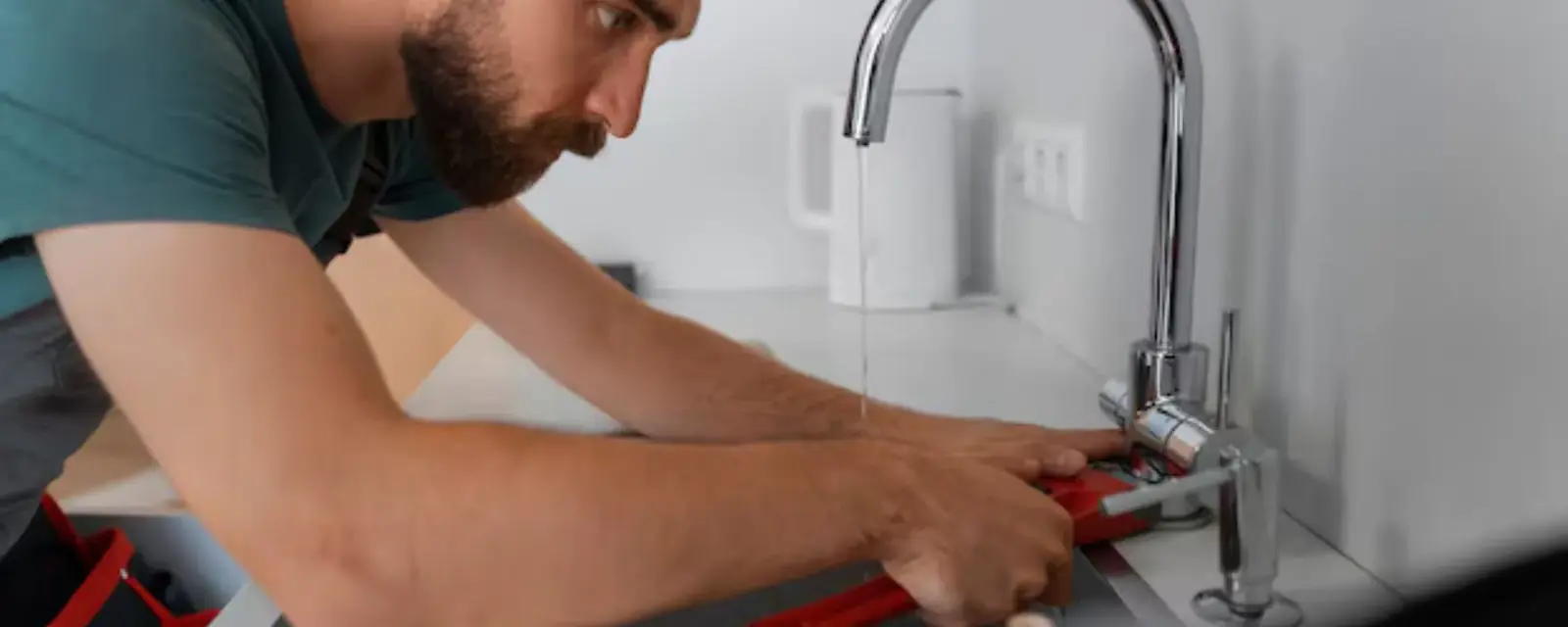
Where the wobble comes from
Grab the faucet and see what moves. The location of the play tells you what to tighten.
| What moves | Likely cause | Do-it-yourself fix | Stop and call if |
|---|---|---|---|
| Whole faucet rocks at the sink deck | Mounting nut or bracket loose | Tighten from under the sink | Nut is corroded or sink is cracked |
| Handle wiggles on its stem | Set screw or cap screw backed out | Tighten with a hex key | Stem is stripped |
| Spout swivels with a gritty feel | Worn O-rings in the base | Replace the rings | Spout leaks at the base after repair |
| Faucet turns on its own base | Missing gasket or deck plate | Reseat the plate and gasket | Sink holes are too large |
| Pull-down spray head sags | Weight or hose clip loose | Reset the hose weight | Hose is cracked |
Tools and prep before you crawl under the sink
Having these within reach saves a second trip to the store.
- Basin wrench.
It reaches the nuts in the tight space behind the bowl that regular wrenches cannot.
- Hex keys and a small screwdriver.
Most handle set screws take a small hex key, and some are hidden under a decorative cap.
- Flashlight and bucket.
A headlamp helps, and a bucket catches the small amount of water left in the supply lines.
- Old towels and a plug.
Plug the drain so no screw or washer falls into the line, and lay a towel under the cabinet floor.
- Plumber's putty or the original gasket.
A new seal under the base keeps water from creeping under the faucet and into the cabinet.
Tightening a loose base, step by step
- 1
Shut off both supply valves.
Turn the hot and cold stops clockwise until they stop, then open the faucet to relieve pressure. If a valve will not turn or drips, do not force it.
- 2
Find the mounting hardware.
Look up from under the sink. You will see either a large plastic or brass nut around each tailpiece or a single plate held by wing nuts. These are what hold the faucet to the sink.
- 3
Tighten the nut with the basin wrench.
Turn clockwise until the faucet no longer rocks, then another quarter turn. Steady the faucet from above while you do it, or the body may rotate.
- 4
Check the spout and handle.
Tighten the handle set screw and test the swivel. A grinding sound or visible movement means the base O-rings have worn and need replacing.
- 5
Turn the water on slowly.
Open the valves, run the faucet, and check every connection with a dry paper towel. A damp towel means something is still loose.
Fixing a spout that swivels loosely
Pull-out and swivel spouts sit on two or three rubber O-rings. Over time hot water and mineral scale harden them, and the spout starts to wobble or weep at the base. Many faucets let you lift the spout straight off after loosening a set screw or a retaining clip.
Take the old rings to a hardware store to match the size, coat the new ones in plumber's grease and slide the spout back on. If the brand is unknown or the faucet is too old for parts, replacing the whole unit often costs less in time than hunting for rings.
Do not overtighten a granite or quartz sink deck
Stone and solid-surface countertops can crack under a mounting nut that is cranked too hard. Tighten until the faucet stops moving, then stop. A rubber gasket between the base and the surface should compress slightly, not squeeze out.
If the sink hole is larger than the faucet base, a deck plate covers the gap but cannot hold the faucet steady. That is when the cause is the hole, not the nut, and a plumber may suggest a different faucet.
Signs the problem is more than a loose nut
Frozen or green-crusted mounting nuts, a bowed sink deck, water stains inside the cabinet and a faucet that drips even after repair all point to something deeper. A slow leak under the sink can soak the cabinet floor for weeks before you smell it.
Supply lines that are kinked or rusted at the nut, or shutoff valves that spin without shutting off, should be replaced at the same visit. Our faucet repair page lists what we check during a faucet call, and a persistent drip at the connection can be traced with leak detection if the water bill suggests a hidden source.
Wildwood water and kitchens: what to know locally
Missouri American Water is the water provider named by the city, and its 2023 report for the St. Louis region lists total hardness between 66 and 150 ppm at its Meramec River plants and between 82 and 226 ppm at its Missouri River plants. The city's Master Plan also notes that many property owners west of State Route 109 are on well water instead. We cannot tell which source feeds your address.
Moderately hard to hard water leaves mineral scale on aerators, O-rings and cartridges, which is a common reason a faucet that was fine at install begins to wobble or stiffen. Check your aerator for white crust. If you are on a private well, test your well once a year through St. Louis County's lab partnership with the city.
On permits, a county flyer hosted on the city's site says a plumbing permit is required to replace or reset sinks and water closets, and the city lists minor repairs as not needing one. Tightening a faucet is a repair, while replacing the sink is not, so ask the building department. Rules differ town by town (Eureka requires a plumbing permit under its own city code, while Chesterfield issues zoning approval itself and takes building permits through St. Louis County).
Sources: utility water quality report, city master plan, county flyer hosted on city site, city website
Faucet leaking at the base after tightening?
Describe where the water shows up, and we will say whether it is a worn seal, a bad supply line or a failing valve.
Questions we hear in Wildwood, MO
The mounting nut or bracket under the sink has loosened from daily use. Tighten it with a basin wrench from below while holding the faucet steady from above.
You can in many cases, because the mounting nut is not under pressure. We still recommend closing both supply valves, since a slipped wrench can pull on a supply line and start a leak.
Do not force it. A corroded nut can snap the faucet shank. Apply penetrating oil, wait, and call a plumber if it still will not turn.
A hidden set screw usually holds the handle to the stem. Pry off the small cap, tighten the screw with a hex key and replace the cap. If the stem is stripped, the cartridge needs replacing.
If parts are unavailable, the finish is peeling, the base is cracked or you have had two repairs in a year, replacement is usually the better choice.
Hard water does not loosen nuts directly, but it hardens rubber seals and builds scale in the swivel base, which makes the spout feel loose or stiff. Clean the aerator, and ask your water utility for its annual water quality report to see the hardness range.
Leave the house and call Spire at 800-887-4173 or 911 from outside before calling a plumber. Do not turn lights on or off or use the phone indoors.
Have a question this page did not answer? Call (855) 575-2890 at any hour and a dispatcher will talk it through.