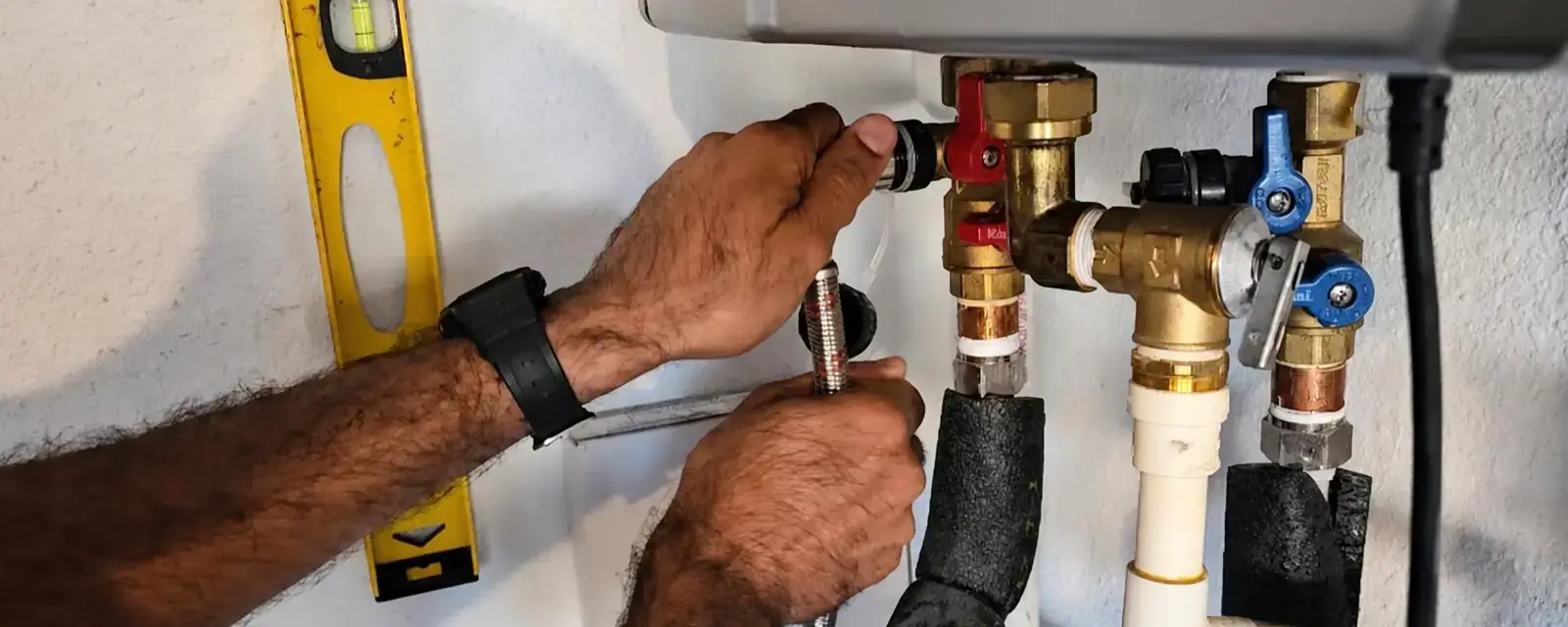
Swap or convert: which job are you pricing?
Most price gaps between quotes come from comparing different jobs. Start by naming yours.
| Job | What changes | What pushes the price up |
|---|---|---|
| Tankless to the same model | Unit swap, isolation valves, condensate line check | Corroded fittings or a vent that fails inspection |
| Tankless to a bigger or newer model | Flow rating, gas input, vent size | A gas line that cannot supply the new input |
| Gas tank to gas tankless | New vent, larger gas supply, drain for condensate, wall mounting | Long vent runs and an undersized gas pipe |
| Electric tank to electric tankless | Large dedicated circuit and heavier wire | A panel with no spare capacity |
| Tankless to tank | Return to a vent or circuit sized for a tank | Removing mounted equipment and patching walls |
| Repair instead of replace | Descale, replace a sensor, or clear a fault | Repeated faults on an old unit with heavy scale |
A written scope should name the model, vent type, and gas or electrical changes.
Flow rate decides the unit, and the unit decides the install
A tankless heater is rated by how many gallons per minute it can raise by a set temperature. A household that runs two showers and a dishwasher at once needs a higher rating than a couple living alone. Cold incoming water makes the same unit deliver less hot water in winter than in July.
Buying too small a unit leads to lukewarm showers when two fixtures run. Buying too large raises gas input, vent size, and cost. Ask the installer to size the unit from your fixture count and your coldest ground water, and to put the rating on the quote.
Gas, venting, and electrical: where bids diverge
Gas tankless units burn at a high rate for short periods. Your existing gas line may be too small to feed one without upgrading, and a longer pipe run lowers delivery. Spire is the gas utility for this area, and any gas line sizing question needs a licensed plumber to answer on site.
Venting is the second big line. Many tankless models use sealed plastic or stainless vent pipe, and some produce condensate that needs a drain. Electric tankless models need a large dedicated circuit, and the panel must have room for it.
If you smell gas at any point during a conversion, leave the building and call Spire at 800-887-4173 or 911 before calling a plumber.
Questions that expose a thin quote
Ask these before you accept any bid, and compare the answers across companies.
- What flow rate does the unit deliver at my winter water temperature?
A vague answer means the unit was not sized for your house.
- Is the gas line sized for the new input?
The answer should refer to your pipe size and run length, not a general claim.
- Are isolation valves included?
They let a plumber flush scale later without cutting pipes.
- Where does condensate drain?
A condensing unit needs a drain path, sometimes with a neutralizer.
- Who pulls the permit and is that fee in the price?
Ask the building department for your address if the plumber is unsure.
- What does the warranty cover?
Heat exchanger, parts, and labor often have different terms.
Scale is the repair bill you can plan for
Minerals build up on the heat exchanger of a tankless unit, restrict flow, and trigger error codes. A periodic flush with a pump and a mild descaling solution through isolation valves clears them. Skipping it is the most common reason a tankless unit dies early.
A homeowner with the right valves and a pump can handle a flush, if the manufacturer's manual allows it. The risk is in closing the gas, shutting the water, and restoring everything in the right order. When a unit throws repeated codes, stop and call, because a failed sensor can look like scale.
Wildwood water hardness and tankless care: what to know locally
Missouri American Water supplies Wildwood, according to the city's FAQ. Its 2023 St. Louis region report prints total hardness as 66 to 150 ppm as CaCO3 for its Meramec River facilities and 82 to 226 ppm for its Missouri River facilities. Dividing by 17.1 gives roughly 3.9 to 13.2 grains per gallon, which is our own arithmetic and not a figure the utility publishes.
The utility's 2025 report, hosted by the Missouri Department of Natural Resources, lists calcium up to 23 mg/L and magnesium up to 15 mg/L, with no hardness row. Using those two numbers, hardness works out to about 119 mg/L as CaCO3, or about 7 grains per gallon. That is calculated from the report, not printed in it, and it does not tell you your tap value.
The reports do not say which plant feeds a given Wildwood address, so we cannot tell you your hardness without a test. Test your tap, ask Missouri American Water for its annual water quality report, and ask your plumber how often to flush based on the result. Homes on private wells may see very different water, so test those separately.
Sources: Missouri American Water 2023 and 2025 water quality reports, Missouri DNR consumer confidence report, City of Wildwood FAQ
Budget for the conversion work, not just the box
When homeowners compare tank and tankless prices, they often compare the unit alone. The install can cost as much as the heater when venting, gas, or electrical upgrades come along. Add walls to patch, a drain to run, and a permit item, and the true comparison is installed price against installed price.
Operating cost then enters the picture. A tankless unit heats on demand, so it avoids standby heat loss, and savings depend on your usage and utility rates. We do not promise a payback period because it varies by household.
Our water heater replacement page covers tank swaps, and water heater installation covers planning and code. For a conversion, call our 24/7 line and we will size the unit and give a clear price before work starts.
Neighbors, same questions
Homeowners in Chesterfield and Ballwin get their water from the same utility system, and they ask the same questions about scale and flow. The difference is the age of the house, which changes pipe and gas line details more than the unit does. Bring your gas meter size and pipe run to any quote conversation.
Planning a tankless swap or conversion?
Tell us the old unit and the fuel, and we will outline what the new install needs.
Questions we hear in Wildwood, MO
The price depends on whether you are swapping like for like or converting from a tank, and on flow rate, fuel, vent, gas line, and permit items. We do not quote a flat number here. A written scope listing each of those items makes bids comparable.
A like-for-like swap reuses the gas line, vent, drain, and mounting. A conversion often needs a larger gas line, a new vent route, a condensate drain, or a heavier electric circuit. Wall repair and a permit item can add to the total.
Harder water leaves more scale on the heat exchanger. Missouri American Water's 2023 St. Louis region report prints total hardness from 66 to 226 ppm as CaCO3 across plants, and it does not say which plant feeds your address. Test your tap, then ask your plumber to set a flush schedule from the result.
If the unit has isolation valves and the manual allows it, many homeowners can run a descaling flush with a small pump. Turn off gas or power first and restore everything in the right order. Call a plumber if error codes return after the flush.
The city's permits page lists new or replaced plumbing among permitted work but does not state a tankless rule by name. Permit rules vary, so ask the building department before you buy the unit.
It can be, because it heats on demand and avoids standby loss. Savings depend on usage and rates, and the install cost may offset them for years. Ask for operating figures from the manufacturer's label next to the installed price.
Leave the building, avoid switches, and call Spire at 800-887-4173 or 911 before calling a plumber. Do not return until a gas safety professional says it is safe.
Have a question this page did not answer? Call (855) 575-2890 at any hour and a dispatcher will talk it through.