Why does my hot water run cold or run out?
People usually reach for a tankless unit after one of three frustrations: a tank that runs out mid-shower, a heater taking up floor space, or a tank that has just failed. A tank holds a fixed volume, so a long shower plus a dishwasher can drain it. A tankless unit has no tank to run dry, but it has a limit of its own: the flow rate it can heat at once.
Each model is rated for a temperature rise at a given flow. In winter, incoming water is colder, so the same unit delivers fewer gallons per minute at the same output temperature. That is why sizing is done against your coldest inlet water and your busiest hour, not an average day.
Tankless vs tank: the honest comparison
Tankless is not automatically the better choice. Here is how the two compare in a typical home.
| Factor | Tankless | Tank |
|---|---|---|
| Hot water supply | Continuous, limited by flow rate | Fixed volume then recovery |
| Expected life | Often cited around 20 years by DOE | 10 to 15 years by DOE |
| Upfront cost | Higher, with extra installation work | Lower |
| Space | Wall-mounted, small footprint | Floor space needed |
| Gas and venting | Larger gas line and special venting | Standard supply and flue |
| Maintenance | Needs periodic descaling | Occasional sediment flushing |
| Simultaneous use | Can struggle if demand exceeds capacity | Draws down the tank |
Life ranges come from the Department of Energy's general guidance. Individual units vary with water quality and care.
Gas supply and venting in plain words
A gas tankless heater burns a lot of fuel in a short burst, so the gas line feeding it must carry more volume than a tank heater needs. Often that means a larger pipe from the meter or a branch, and sometimes a regulator change. We size the gas line from the unit's rated input and the length of the run.
The exhaust is the other half. Most tankless units use sealed, fan-driven vents, many in plastic or stainless depending on the model, and condensing types need a drain for acidic condensate. The manufacturer's manual dictates vent material, length and clearance. If you smell gas at any point, leave the building and call Spire at 800-887-4173 or 911 before calling a plumber.
Thinking about going tankless?
Call with your fuel, number of bathrooms and what runs at the same time. We will tell you what the install would involve.
Flush and descale: what hard water does to a tankless unit
Scale is the leading cause of service calls on tankless heaters. As water heats inside the exchanger, dissolved calcium and magnesium come out of solution and coat the inner surfaces. The coating insulates the metal, reduces flow, triggers error codes and shortens the life of the unit.
Missouri American Water supplies Wildwood. Its 2023 report lists total hardness of 66 to 150 ppm at Meramec plants and 82 to 226 ppm at Missouri River plants. The 2025 report does not publish a hardness row, but its calcium and magnesium work out to about 119 mg/L, our calculation. Homes on private wells must test their water, since well hardness is unknown without a lab result.
A descale flush circulates a mild acid, usually white vinegar or a manufacturer-approved solution, through the exchanger using a small pump and the unit's isolation valves. Manufacturers generally call for it at intervals set by water hardness, so follow the manual for yours. Hard water or a well makes more frequent flushing sensible.
Signs your tankless heater needs a flush
These symptoms are common when scale has built up, though other faults can look similar.
- Error codes.
Many models flag restricted flow or overheating. The manual's code table points to scale, a clogged inlet filter or a failed sensor.
- Lower flow.
Hot water arrives, but less of it. Clogged inlet screens or scaling in the exchanger are common causes.
- Temperature swings.
The temperature wanders between hot and warm. This can be scale or a sensor problem.
- Noise.
Popping or knocking in the unit can signal mineral buildup on the exchanger.
- No isolation valves.
If your unit has none, a flush needs valves added first. We install them as part of the service.
Honest drawbacks
Tankless units cost more up front and often need gas, venting or electrical upgrades. Some give a short burst of cold water between uses, and very low flows may not trigger the burner. Many homeowners find that hot water arrives a little later, because water in the pipes between the unit and the fixture has to be flushed out first.
Electric tankless units pull a very large load, so they may require a panel upgrade. If your hot-water use is low or your gas line is hard to upgrade, a good tank or a heat pump model may serve you better, and we say so.
Installation and repair: how we handle each
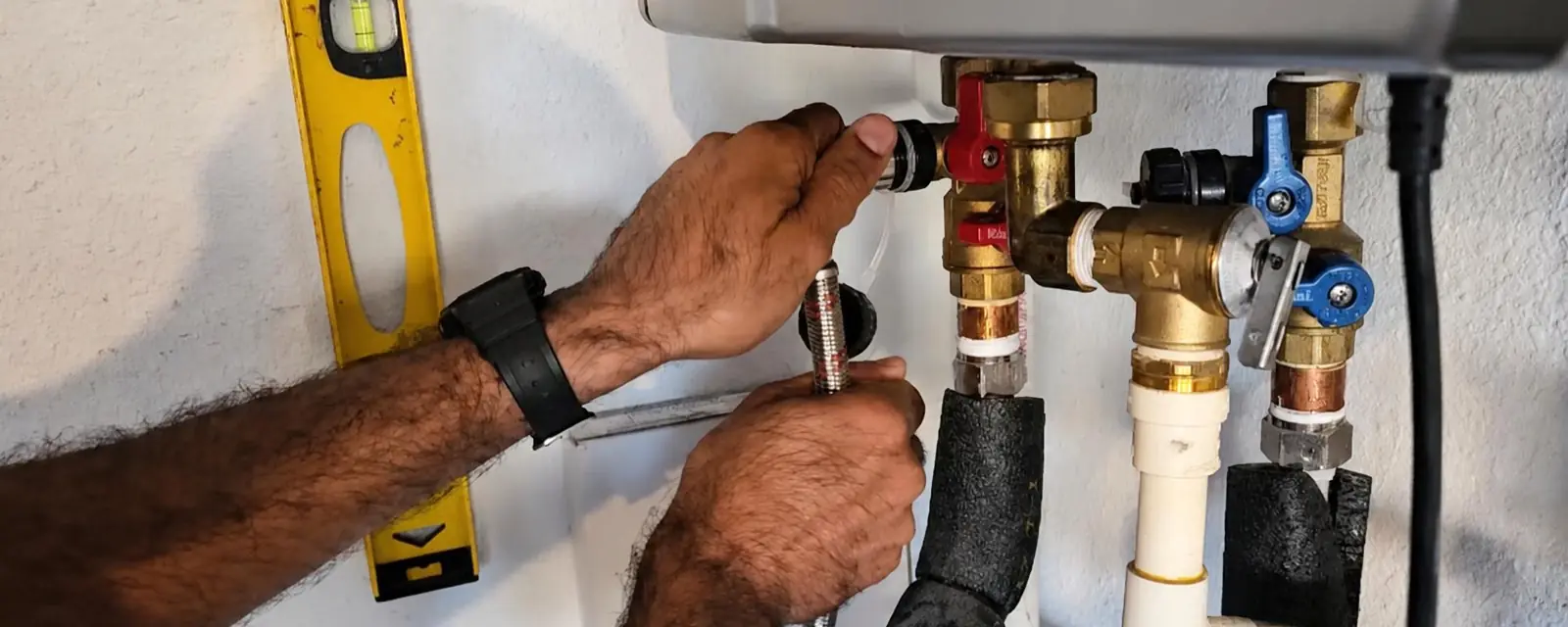
For a new tankless install we walk the house, measure gas pipe, plan the vent route and check electrical supply. Sizing considers the number of bathrooms and the coldest inlet water. The planning side overlaps with our water heater installation work, including code and permit questions.
For repair, we read error codes, inspect the inlet filter, test flow and temperature sensors, check gas pressure and venting, and flush if scale is the cause. Permit rules vary, so ask the Wildwood building department before replacing or installing any heater.
How a tankless flush visit goes
- 1
Check the history.
We read the model, error codes and the last service date and ask about water source.
- 2
Isolate and connect.
Water, gas or power is shut off. The flush kit connects to the isolation valves.
- 3
Circulate the solution.
The pump runs the descaling solution through the exchanger for the time the manufacturer specifies.
- 4
Rinse, clean the filter and test.
We rinse the system, clean the inlet screen and restart the unit. Flow and temperature are verified.
What affects the price of a tankless water heater
Prices are not published here. Gas line, venting and unit selection change the total, and you get a clear price before work starts.
Bigger units that serve more bathrooms or larger households cost more.
A larger gas pipe adds materials and labor, depending on the distance from the meter.
Longer or more complex vent runs and condensate drains add to the job.
Electric tankless models may need heavy wiring and breaker capacity.
Adding a softener or scale filter to protect the exchanger is a separate cost.
Tankless installation and descaling are normally owner expenses. A sudden leak that damages the house may fall under your policy, while scale or wear generally does not. Your policy decides.
To price your home, call us for a visit.
Protecting the unit with water treatment
If your water is hard or comes from a well, a water softener or scale filter can reduce how often you descale. We cannot tell you your hardness without a test, so check the utility's annual report or use a home test kit or lab. We also service tankless units in Eureka, Ellisville and nearby towns.
Questions we hear in Wildwood, MO
Common causes are scale in the heat exchanger, a clogged inlet screen, low flow at the fixture or a unit sized too small for winter inlet temperatures. A flush and a flow test usually narrow it down.
Manufacturers set the interval by water hardness, and many suggest at least yearly. Hard water or a private well may call for more frequent service. Check your unit's manual and ask us.
Missouri American Water's 2023 report lists total hardness of 66 to 150 ppm at Meramec plants and 82 to 226 ppm at Missouri River plants. Which plant serves your address is not something we can state. Test your tap.
Yes, but well water must be tested first. Sediment, iron and hardness can foul the exchanger. St. Louis County recommends annual well testing, and the city partners with the county health laboratory for kits.
Usually yes. These units burn a lot of fuel in a short time, so the pipe has to carry more volume than a tank heater needs. We size it from the unit's rated input.
Leave the building and call Spire at 800-887-4173 or 911 from outside. Do not use switches or open flame. A plumber can work on it once the utility declares the building safe.
Have a question this page did not answer? Call (855) 575-2890 at any hour and a dispatcher will talk it through.