Why is there white crust on my faucets and spots on my glasses?
White crust around faucet bases, cloudy glassware, soap that will not lather and stiff laundry are the usual signs of hard water. Dissolved calcium and magnesium come out of solution when water dries or heats, and they leave scale behind. Inside the house the same process coats heating elements and tank floors, which is why a water heater can get noisy and inefficient.
A water softener addresses that by swapping hardness minerals for sodium or potassium on a bed of resin beads. It does not remove every contaminant, and a filter does a different job. Knowing which problem you have comes first, and the only way to know is to test.
What we know about Wildwood water, and what we do not
Missouri American Water supplies the city with treated surface water. Its 2023 report lists total hardness of 66 to 150 ppm at its Meramec River plants and 82 to 226 ppm at its Missouri River plants. The 2025 report lists calcium and magnesium but no hardness row. Calculated from those two numbers, hardness is about 119 mg/L, our calculation and not a utility figure.
Neither report says which plant feeds your street, and we will not guess a number for your address. Test your tap, and ask your water utility for its annual water quality report. Dividing ppm by 17.1 gives grains per gallon, the unit most softener settings use.
Private wells: test before you buy anything
The City of Wildwood Master Plan notes that many property owners west of State Route 109, and some to the east, are on well water. Well chemistry can differ sharply from one property to the next, with hardness, iron, sulfur and bacteria all possible. A softener sized for hardness alone can be fouled by iron.
The city partners with the St. Louis County Department of Health laboratories for private well testing, and kits are available at City Hall. St. Louis County recommends testing a well once a year. A lab report tells us what to specify, and we can match a softener, an iron filter or a sediment stage to the results.
Ready to treat your water?
Call with your lab report or utility report in hand, and we will recommend equipment sized to your results.
Softener or filter: which problem does each solve
The terms get mixed up, but the equipment is different.
| Problem | Typical fix | Notes |
|---|---|---|
| Scale, spots, stiff laundry | Water softener | Ion exchange resin, needs salt or potassium |
| Chlorine taste and odor | Carbon filter | Replace the cartridge or media on schedule |
| Sediment, grit | Sediment filter | Often paired with a well |
| Iron staining | Iron filter or softener with iron capacity | Depends on iron level and form |
| Drinking water only | Point-of-use filter at the sink | Does not protect the whole house |
| Bacteria in well water | Disinfection, after a lab test | Treat the cause, not just the tap |
A lab report or test strip result should drive the choice, not a sales brochure.
How a softener works: sodium and regeneration
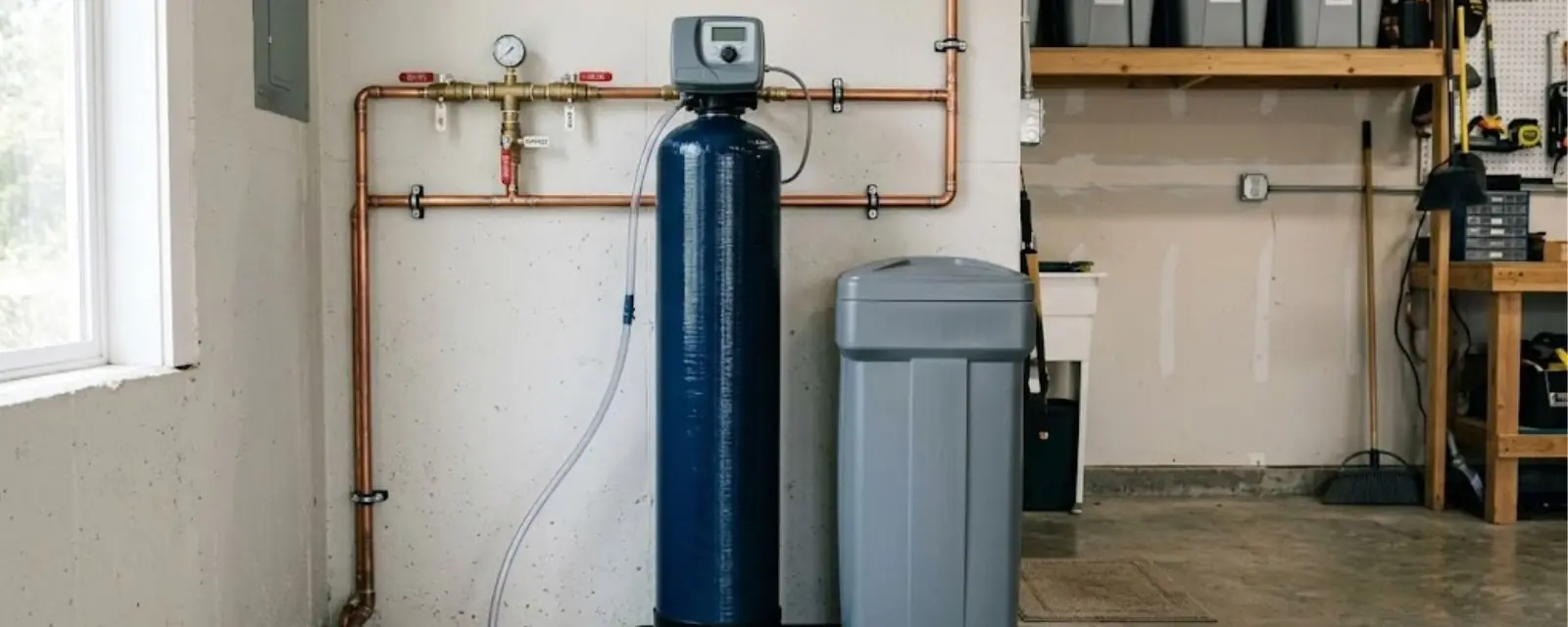
Hard water passes through a tank of resin beads. The beads hold sodium and swap it for calcium and magnesium. Over time the beads fill up, and the softener regenerates by flushing the bed with brine from a separate salt tank, then rinsing the hardness down the drain.
Regeneration runs on a timer or a water-usage meter, usually overnight. Sodium added is small for most households, but people on sodium-restricted diets should ask their doctor. Potassium chloride can replace salt, though it costs more. Many families also leave one cold tap unsoftened for drinking or plumb the outdoor hose spigots ahead of the unit.
Softener maintenance that keeps it working
Most softener calls come from skipped basics. A few checks go a long way.
- Salt level.
Keep the brine tank at least a third full, and use the salt type the manufacturer specifies.
- Salt bridging.
A hard crust can form over empty space below, so the unit makes no brine. Break it up and clear the tank.
- Brine tank cleaning.
Sludge at the bottom can plug the intake. An occasional cleanout prevents it.
- Resin cleaner.
On iron-bearing water, a resin cleaner helps keep beads from fouling.
- Settings.
Hardness, capacity and regeneration time should be reviewed after any change of water source.
- Bypass valve.
Know where it is. It lets you isolate the unit for service or leave it off while you test.
How a softener connects to your plumbing
A softener sits on the main water line, usually after the pressure reducing valve and before the water heater. It needs an inlet and outlet with shutoffs and a bypass, a power outlet for the control head, and a drain for the regeneration discharge. That drain must have an air gap so wastewater cannot siphon back into the unit. Standing wastewater near the softener is a red flag.
Installation touches your supply piping, a drain connection and sometimes the electrical outlet, so it overlaps with our plumbing installation work. Permit rules vary, so ask the Wildwood building department. A leaking softener tank, stuck valve head or overflowing brine tank is serviced the same way as any other plumbing leak.
What a softener visit involves
- 1
Review your test.
We look at the utility report or lab result and the household's water use.
- 2
Size and place.
Capacity is matched to hardness and daily use, and the location is picked for drain, power and bypass access.
- 3
Plumb and set.
Shutoffs, bypass and drain with air gap go in, the unit is loaded with salt and programmed.
- 4
Regenerate and check.
We run a manual regeneration, test the water downstream and walk through the controls with you.
What affects the price of water treatment
No prices are quoted here. You get a clear price before work starts, based on your water and your house.
A basic softener, an iron-capable system and a multi-stage well setup are in different price classes.
Larger households and harder or iron-rich water need more resin and a bigger tank.
Tight spaces, long runs to a drain and old shutoffs add labor.
No outlet or floor drain near the unit means extra work.
Salt, cartridges and occasional service are part of the real cost of ownership.
Water treatment equipment is usually an owner expense. A burst line or flood from a failed tank may be covered sudden damage, but wear is not. Your policy decides.
To price your setup, call us with your test results.
Repairs and whole-home filtration
We repair softeners that will not regenerate, leak at the valve head or run out of salt too fast. Whole-home carbon and sediment filtration is a smaller part of our work, and we match it to what the test shows. Hard water often shows up first at the water heater, and homeowners in Eureka and Ballwin ask about it as well.
Questions we hear in Wildwood, MO
Missouri American Water's 2023 report lists total hardness of 66 to 150 ppm at Meramec plants and 82 to 226 ppm at Missouri River plants. We cannot say what your tap measures without a test. Ask your utility for its annual water quality report.
For hardness, a home test strip or a lab test works. For a private well, the city partners with the county health laboratory and recommends testing once a year. Kits are available at City Hall.
Those signs point to hardness, but test first. A softener helps with scale and spots. It will not fix chlorine taste or sediment, which need a filter.
Softening swaps hardness minerals for sodium or potassium. The amount depends on how hard your water is. Anyone on a restricted-sodium diet should ask a doctor, and potassium chloride is an option.
It depends on hardness, household size and the unit. Check the tank monthly and keep it at least a third full. A bridged salt crust can mimic an empty tank.
Yes, in most cases. We look at the valve head, resin and brine tank, test the output and tell you whether repair or replacement makes sense.
Have a question this page did not answer? Call (855) 575-2890 at any hour and a dispatcher will talk it through.