Why does my basement get damp when it is not leaking?
A damp floor, a musty smell or a wet line along the wall base can come from three different sources. Groundwater can push through the wall and floor joint. A plumbing pipe, drain or water line can leak into the slab or wall. Humidity from the air can condense on cool concrete and pipe.
Each source needs a different fix, and guessing wrong costs money. Waterproofing is the umbrella term, but the real work starts with finding which water you have. That is why the first step in a plumbing-side check is to rule pipes in or out.
What a plumber can fix and what belongs to a foundation specialist
Here is the honest division. We do plumbing-side work, and some basement water problems are not plumbing.
| Problem | Plumbing-side work | Other trade |
|---|---|---|
| Water collects in a low spot | Sump pit and pump, interior drain connection | None |
| Pipe or drain leaking into the slab | Leak tracing and repair | Flooring repair |
| Floor drain backs up | Drain cleaning, check valve, camera | None |
| Wall cracks leaking | No | Foundation repair contractor |
| Bowing or shifting wall | No | Structural engineer or foundation specialist |
| Exterior wall sealing or excavation | No | Excavation and waterproofing contractor |
We do not do structural foundation repair, crack injection or exterior excavation. If we find those are the cause, we will say so and send you to the right trade.
Wildwood's hills, soils and rain
The city's Master Plan describes Wildwood as rolling and hilly woodlands of the Ozark Foothills, with steep terrain and erosion-sensitive soils. Manchester Road follows a ridge line that divides drainage toward the Meramec River to the south and the Missouri River to the north. The Master Plan also notes the historic community of Centaur was once a center of limestone manufacturing, and the Missouri Department of Conservation describes Ozark-style terrain with springs, caves and rock formations at Rockwoods Reservation.
The practical point is that water follows slope and rock. A house on a hillside may take runoff from uphill, and a basement in a drainage swale collects it. We cannot say what lies under your lot, so a plumber's visit cannot replace a soil or foundation report if one is needed.
For rainfall, the National Weather Service lists a normal of 41.70 inches a year at its St. Louis station. That is a regional figure, not a Wildwood gauge. It helps explain why a basement that stays dry in a dry year may flood in a wet one.
Plumbing sources of basement water
Before anyone digs, rule these out.
- A leaking supply or drain pipe.
Water appears after a plumbing fixture is used, not just after rain. Our leak detection methods include pressure tests and moisture meters.
- A failed sump pump or clogged pit.
If the pit overflows, the water comes from the groundwater the pump should handle.
- A floor drain backup.
Water rises through the floor drain when the main line is slow or blocked. A camera shows whether the cause is roots, grease or a collapsed pipe.
- A leaking water heater or softener.
These sit in many basements and can mimic a wall leak.
- A washing machine or sink line.
A hose failure floods quickly and is easy to miss.
Not sure whether it is a pipe or the foundation?
Call us and describe when the water appears. Timing after rain versus after using water is a strong clue.
Interior drains, drain tile and sump pits
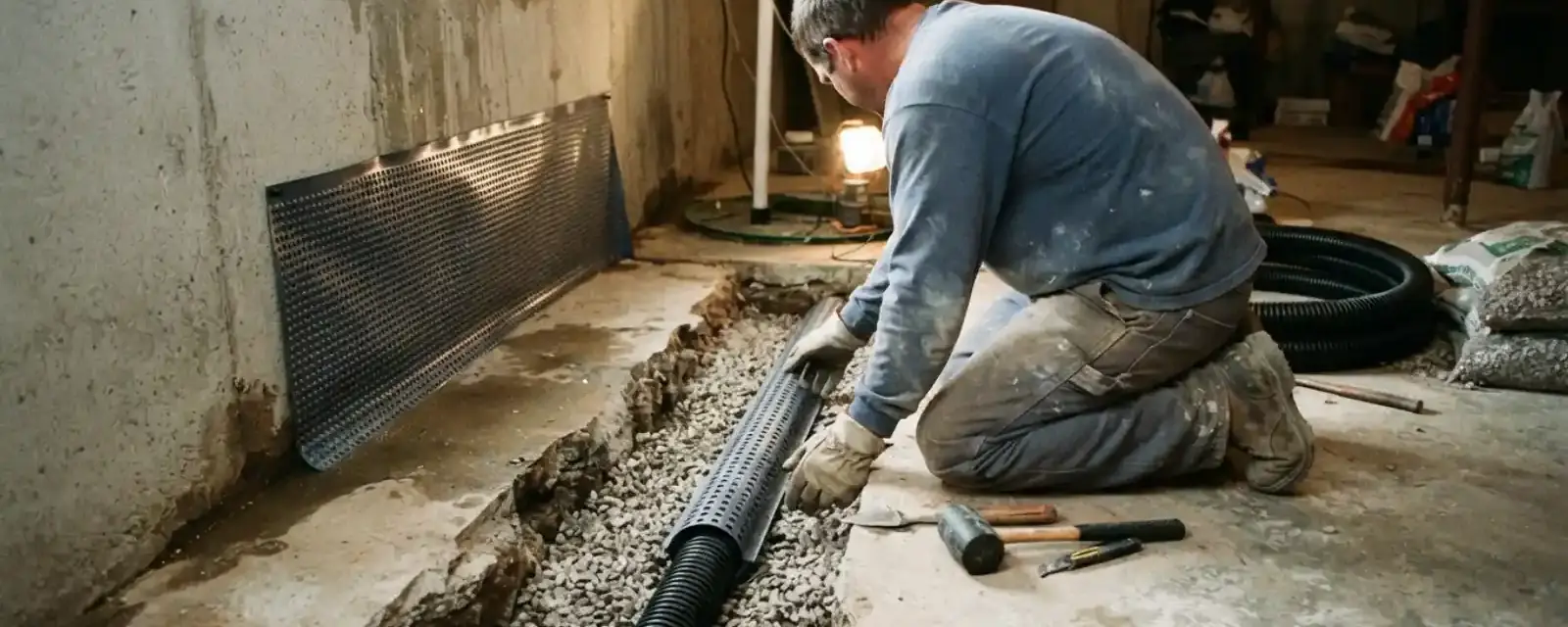
The plumbing-side answer to groundwater is an interior drainage system. A channel cut along the wall and floor edge collects water and carries it to a sump pit, where a pump discharges it outside. Drain tile, a perforated pipe in gravel, does the same job around or under the slab.
The system works best when water enters at the wall joint. It does not stop water entering through the wall, and it does not repair cracks. It manages the water you cannot keep out. Because the system relies on a pump, battery backup matters. See our sump pump page for pump choices and storm power loss.
Slab work is intrusive. Permit rules vary, so ask the building department before cutting concrete or changing where water discharges.
Drain connections, floor drains and sewer backup
A floor drain tied to the sanitary line can bring sewage into a basement when the main is blocked. That is not groundwater, and it needs drain cleaning or a camera check, not a sump. A backwater valve can be added in some cases, and a plumber can advise whether it suits your line.
The city says sewer service is MSD Project Clear, but many homes outside the district use private systems. If your basement has gurgling drains and you are not on public sewer, tell us so we plan the check around your system.
What affects the price of plumbing-side waterproofing
There is no single number because jobs differ widely. These factors drive the price.
A short run to one pit costs less than a drain around the whole basement.
Breaking concrete and patching add labor, and finished floors raise the cost.
A larger pump and battery backup add equipment.
Camera and pressure tests may be needed before a quote is accurate.
A long run to a safe outlet adds pipe and trenching.
Many homeowner policies exclude groundwater seepage and gradual leaks, while a sudden pipe burst may be covered. Flood damage is usually a separate policy. Your policy decides.
For a clear price before work starts, call us and describe where and when water appears.
How a plumbing-side basement assessment goes
- 1
Map the water.
We note where it appears, when, and whether it follows rain or fixture use.
- 2
Test the plumbing.
We check supply pressure, fixtures, drains and the sump pit, with a camera if needed.
- 3
Explain the findings.
We tell you whether the cause is plumbing, groundwater or structural.
- 4
Quote the plumbing work.
You get a clear price before work starts, and a referral note if the fix belongs to another trade.
Questions we hear in Wildwood, MO
Humidity, a slow pipe leak or damp soil behind a wall can all cause it. A moisture meter and a pressure test help us separate a plumbing leak from damp air.
No. We do plumbing-side work: sumps, drains and leaks. For cracks, bowing walls or exterior sealing, a foundation specialist is the right call.
It controls groundwater that reaches the pit. It does not seal walls, so moisture coming through cracks may remain. See our sump pump repair page.
Often yes. Timing is the clue: water that shows up after you run fixtures points to plumbing, and water after rain points to groundwater.
Hills, erosion-prone soils and a ridge line between two river drainages shape how water moves, per the city's Master Plan. We cannot judge your lot from afar, so a visit is needed.
Permit rules vary, so ask the building department before cutting the slab.
Yes. We cover Eureka, Chesterfield and the rest of Wildwood.
Have a question this page did not answer? Call (855) 575-2890 at any hour and a dispatcher will talk it through.