Plumbing-side fix or structural repair: sorting your problem
Most water-in-the-basement stories fall into one of two groups. Figure out which before you spend money, since the wrong fix wastes the budget.
| What you see | Likely side | Right kind of fix |
|---|---|---|
| Damp patches on the wall, no standing water | Humidity or minor seepage | Dehumidifier, gutter and grading check, masonry sealer |
| Water along the wall-floor joint after rain | Hydrostatic pressure, plumbing side | Interior drain channel and sump pump |
| Water rising through a floor crack | Groundwater under the slab | Sump pit and drain tile, sometimes crack repair |
| Horizontal crack or a bowing wall | Structural | Foundation contractor or engineer first |
| Stair-step cracks in block or brick | Settlement, structural | Foundation specialist, not a sealer |
| Water only after a pipe or appliance fails | Plumbing leak, not groundwater | Leak repair, not waterproofing |
We do plumbing-side waterproofing: drains, sump pumps and leaks. We do not repair foundation walls.
What actually keeps a basement dry
Water gets into a basement because soil outside the wall becomes saturated and pushes water through any gap it can find. Fixing the inside never removes that pressure. It gives the water a place to go before it reaches your floor.
That is why the cheapest and often most effective steps are outside. Gutters that discharge several feet from the foundation, downspout extensions, and soil that slopes away from the wall can cut the water arriving at the foundation. If you have not checked those, check them before any interior work.
What you can do yourself before calling anyone
These steps are cheap and help you describe the problem accurately.
- Check the gutters and downspouts.
A clogged gutter spills water straight down the foundation wall. Extend each downspout so it ends well away from the house.
- Look at the soil slope.
Soil that settles toward the wall holds water against it. Add compacted fill so it falls away.
- Do a plastic sheet test.
Tape a small sheet of plastic to the wall for two days. Moisture under the plastic is seepage. Moisture on top is humidity.
- Photograph after a rain.
Note where water first appears and how long it takes. That tells the installer where the drain and pit belong.
- Test your sump pump.
Pour a bucket of water into the pit and confirm it starts, empties and shuts off.
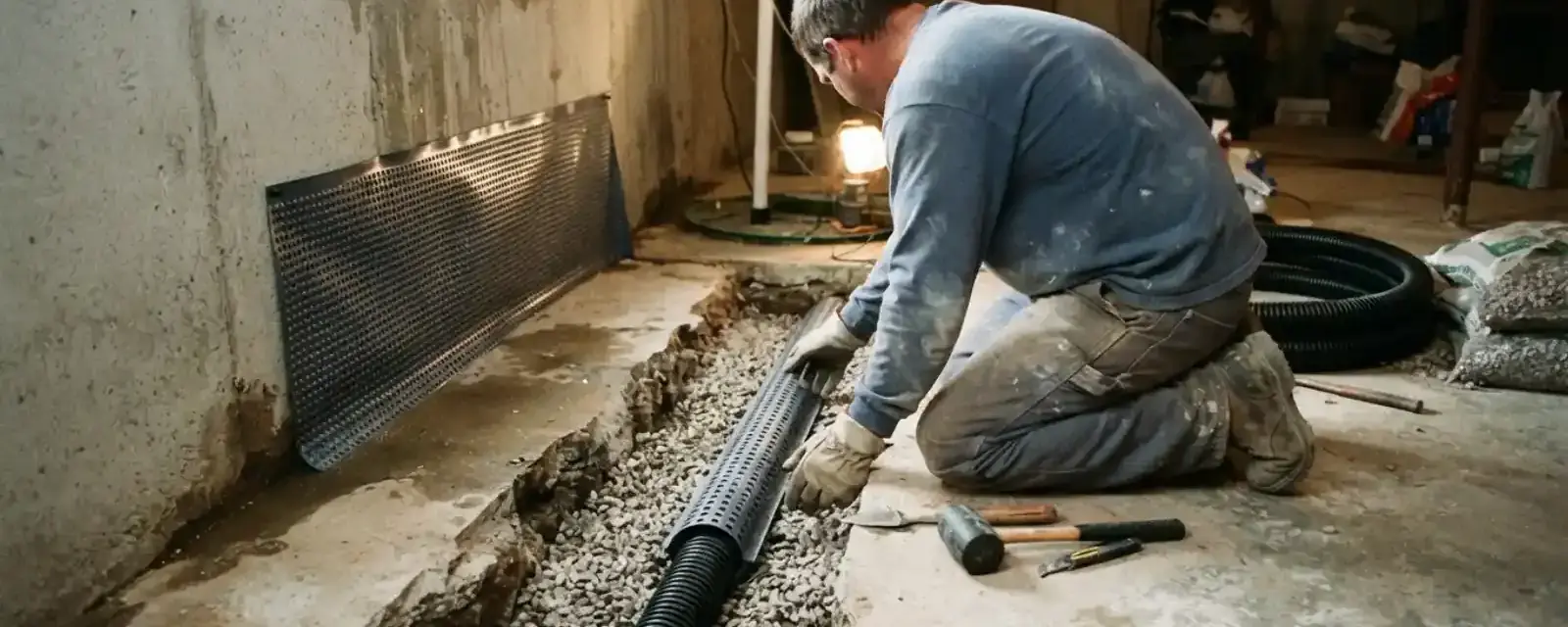
How an interior drain system is installed
- 1
Open the floor along the wall.
A strip of concrete about a foot wide is cut and removed along the perimeter where water enters.
- 2
Lay the drain channel.
A perforated pipe or channel is set in gravel along the footing, sloping toward the sump pit, so water flows to it by gravity.
- 3
Set the sump basin.
A pit is dug and lined at the low point. Our sump pump installation and repair page covers the pump and check valve.
- 4
Patch the slab.
Fresh concrete is poured over the drain, leaving a small gap at the wall edge for water to enter the channel.
- 5
Test with water.
The installer pours water along the channel to confirm it reaches the pit and the pump clears it.
Safety before you wade into a wet basement
Water and electricity do not mix. If water is at or above outlets or an appliance, do not step in until the power is off at the panel, and if the panel is in the wet area call an electrician or the utility first.
Furnaces and water heaters in basements often burn gas. If you smell gas, leave the building and call Spire at 800-887-4173 or 911 from outside before you call a plumber. Do not try to relight a pilot or turn switches in a flooded space.
Why paint-on sealers have limits
Masonry sealers and waterproof paints can stop slight dampness on a wall that is otherwise dry. They cannot hold back water pushing in under pressure, and they often peel when water gets behind them. A bubbled or flaking coating is a sign that water is behind it.
If you plan to finish the basement, solve the water first. Carpet, drywall and framing on a seeping wall go moldy fast. For a deeper look at what we do, see our basement waterproofing page, and if you are not sure whether the dampness is a leak, leak detection can rule out a pipe.
Questions to ask before you accept any interior waterproofing quote
A good answer to each of these shows the contractor has looked at your basement and not at a brochure.
- Where is the water coming from?
A contractor who cannot name an entry point, such as a wall joint, a floor crack or a window well, is guessing.
- Where does the pumped water go?
The discharge should end outdoors on your own lot, away from the foundation, and not into a sanitary sewer line.
- What happens when the power goes out?
Ask about battery backup. A pit and pump that stop during a storm outage protect nothing.
- Will you check for a structural problem first?
If a wall is bowing or cracked, the right first call is a foundation specialist, and an honest installer will tell you so.
- What does the quote leave out?
Electrical work, floor patching, trim removal and permit fees can all be separate lines.
Wildwood ground, creeks and floods: what to know locally
Wildwood's Master Plan describes rolling, hilly Ozark Foothills woodlands with erosion-sensitive soils, and the Missouri Department of Conservation describes Rockwoods Reservation as terrain with springs, caves and shaded ravines. A lot near a ravine or slope may see seepage only after storms, so a dry-weather look can miss the problem.
The Meramec River forms part of the city's southern boundary. The National Weather Service recorded a record Meramec crest of 46.06 feet at Eureka on December 30, 2015, after storm rain of 7.85 inches at Eureka and 9.48 inches at Chesterfield. That document does not mention Wildwood, so we cannot say what happened in any one basement. If your lot is near the river, ask how it fared before you buy.
Neighbors learn from each other. Basements near the river in Eureka and near creek corridors in Ellisville face different water than a hilltop home in Wildwood. Take photos after rain so you can show a contractor what happens at your address.
Sources: city master plan, state agency (Missouri Department of Conservation), National Weather Service event report
Not sure if it is plumbing or the wall?
Describe where and when the water appears, and we will tell you honestly if it is ours to fix or a foundation contractor's.
Questions we hear in Wildwood, MO
You can manage water that reaches the foundation with drain channels, a pit and a pump. You cannot stop outside soil from pushing against the wall, and an interior system does not repair cracks or a bowing wall.
Exterior waterproofing keeps water off the wall but means digging up the foundation. Interior systems are less disruptive and handle water that has already arrived. Many homeowners choose interior because digging outside is costly or blocked by decks and landscaping.
In most cases yes, since the drain needs a low point to flow to and a way to send water out. In rare cases a gravity outlet to daylight works on a sloped lot.
Tape a small piece of plastic to the wall and check it in two days. Moisture beneath it is seepage through the wall, and moisture on the outer face is condensation.
Only for slight dampness. It cannot stop water that is under pressure and often peels after a wet season.
Not automatically. Hilly lots can send runoff toward a foundation, but many basements stay dry. Watch your own after heavy rain, and fix the gutters and grading before spending on interior work.
Waterproofing handles groundwater that comes from outside. A plumbing leak comes from a supply line, drain or appliance, and it needs repair, not drainage.
Have a question this page did not answer? Call (855) 575-2890 at any hour and a dispatcher will talk it through.