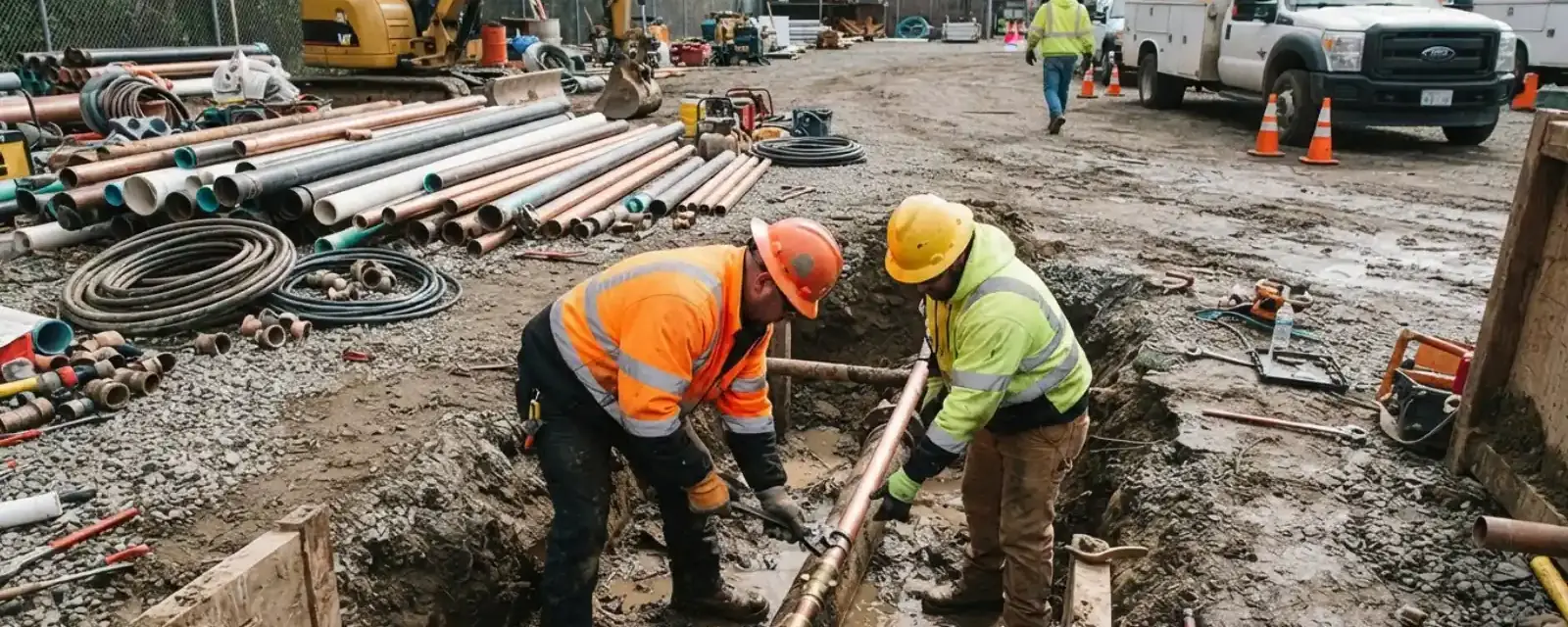
Why has my water pressure dropped, or my yard turned soggy?
A buried water line rarely announces itself. You might see weak flow at every tap, a meter that spins with the house quiet, a wet strip between the street and the front door, or a sinkhole forming on the lawn. Those clues often point to a leak or break in the service line.
The service line is the pipe that crosses the yard. It is different from the plumbing inside the house, which is why a low-pressure complaint can have a cause at the street, in the yard or behind the walls. Checking each stage in turn is how we avoid replacing pipe that is fine.
City water or a private well: two repair paths
The City of Wildwood says water in the city is provided by Missouri American Water. The Master Plan also says many property owners west of State Route 109, and some to the east, are on well water. Which one you have affects who you call and what gets repaired.
If you are on Missouri American Water
Your line runs from the main in the street through a meter and on to the house. In general, the utility cares for the main and the homeowner for the pipe on the private side, but where responsibility ends varies by account and location, so ask your utility where its responsibility ends before digging or hiring anyone. The customer service number is on your bill.
If you are on a private well
The whole line from the well to the house is yours, along with the pressure tank, shutoff and any branch to a barn or outbuilding. Long runs on large lots mean more places to fail. After any repair that opens the line, test the water. St. Louis County recommends that well water be tested once a year, and the city partners with the county health lab for kits.
When a broken water line is an emergency
Treat it as urgent if water is surfacing in the yard, if the house has lost all pressure, or if a basement wall is taking on water where the line enters. Our dispatch line is open 24/7, and a licensed plumber will start with a safe shutoff and a plan.
Close the main valve inside the house. If water is flowing ahead of your shutoff, call Missouri American Water using the number on your bill so the utility can address its side. Keep out of any pooled water near the meter box or an electrical panel, and photograph the wet area for your records.
Yard flooding or no water at all?
Call and describe what you see. If it can wait until morning, we will say so, and if it cannot, dispatch starts right away.
Repair, partial replacement or full replacement?
The right choice depends on how the pipe has failed and how much of it is in poor condition.
| Situation | Likely approach | Why |
|---|---|---|
| One clean break, rest of line sound | Spot dig and repair | Smallest excavation and fastest return of water |
| Several leaks along the same run | Replace that section | Patching tends to move the problem to the next weak spot |
| Old steel line, rusted and low flow | Replace the full line | Corrosion limits flow and keeps leaking |
| Line under a driveway or retaining wall | Trenchless replacement | Avoids cutting hard surfaces where site conditions allow |
| Well line with frequent breaks | Replace the exposed run | One longer run has fewer joints to fail than many patches |
Trenchless methods depend on soil and layout, so we confirm feasibility on site.
Finding a leak you cannot see
Locating comes before digging. A pressure test on the line, acoustic listening along the route and, when needed, tracer gas help us place the dig within a few feet. Without it, a trench follows the wrong guess and the yard pays for it.
In hilly terrain, water often does not surface above the break. The Master Plan notes steep terrain and soils sensitive to erosion across much of the city, so a leak can wash soil away, track downhill and appear near a driveway edge or ditch. For the full process, see our leak detection page.
Low water pressure: causes beyond the underground line
Not every pressure drop comes from the yard. A failing pressure regulator, a half-closed valve, mineral buildup in old galvanized pipe, clogged fixture aerators and a utility-side event all reduce flow. A utility-side event usually affects neighbors, so a quick conversation with a nearby household or a check of utility notices helps.
For a well, the pressure tank, switch and pump all matter. A tank that cycles on and off every few seconds or sputters at the tap points to the system, not the buried pipe. We say clearly when a pump or well casing needs a specialist.
The test we start with is simple. Attach a gauge to an outdoor spigot, read the static pressure, then run water and watch how far the reading falls.
What the street and the cold can do to your line
A local TV report said Missouri American Water issued a precautionary boil advisory for part of Wildwood in January 2025 because of operational problems at a plant. The city also posted that month that frozen pipes and other water line issues tend to rise in cold weather, and it listed utility main breaks near Lake Chesterfield.
Utility-side events like these can change pressure or clarity for whole streets. If your water is discolored or weak, first look for a utility notice, then check inside the house. If only your home is affected, the cause is on the private side, and that is where we come in.
How a service line repair goes
- 1
Shutoff and symptom check.
We confirm which valves you can control, close the main and note whether the meter or the pressure tank still moves.
- 2
Locate the break.
Listening gear, a pressure test and the routing of the line narrow the dig to a few feet.
- 3
Mark utilities and dig.
Buried utilities are marked through the call-before-you-dig process before any excavation starts.
- 4
Repair or replace.
We cut out the failed pipe and join new pipe, or run a longer replacement when the line is worn.
- 5
Test and restore.
We pressure test, flush the line and backfill. Surface restoration such as sod or paving is a separate step we discuss in advance.
What affects the price of a water line repair
A service line job can be small or large. You get a clear price before work starts, after the break has been located.
A short run through lawn costs far less than a long run through rock, roots or a slope.
Cutting through a driveway, patio or retaining wall adds both labor and restoration.
Material cost and fittings differ among copper, polyethylene and steel.
Well lines can be longer, and tank or pump connections may be part of the work.
Rules vary by project, so ask the building department, and we will tell you what your repair involves.
Some homeowners policies cover accidental damage to underground lines and some sell it as an add-on. Wear and corrosion are often excluded. Your policy decides, so ask your insurer before work starts and keep photos of the break.
For a number on your line, call our 24/7 line and tell us whether you are on city water or a well.
If the leak turns out to be inside the house
Sometimes the meter runs because of a failing pipe inside the walls, not the yard. A burst pipe repair covers a split line, and if the house plumbing is worn throughout, repiping is the longer-term answer. Our dispatch also covers homes in Eureka and Chesterfield, right up to the edge of Wildwood.
Questions we hear in Wildwood, MO
Yes. Dispatch runs 24/7, including nights, weekends and holidays, and same-day appointments are offered when available. Close the main inside your house, keep clear of flooded ground and call.
In general, utilities maintain the main in the street and homeowners maintain the pipe on the private side, but the dividing point varies. Ask your utility where its responsibility ends, and ask before you dig.
We repair the piping between the well and the house, and the connections at the pressure tank. Pump motors and well casings are separate work, and we will tell you if that is the cause. Test the water after any repair that opens the line.
That usually points to something inside the house, such as clogged aerators, a failing valve or corroded pipe. If pressure is low everywhere, the service line, the regulator or a utility event is more likely.
No. Buried gas, electric and other utilities may be nearby, and a wrong cut can make things worse. The national 811 call-before-you-dig line should be contacted before any excavation.
Turn off everything inside, then check the meter for movement. If it keeps moving after you close the house main, the leak is between the meter and the house. Call us for a leak search.
The city's building permit page lists new or replaced plumbing among work that needs a building permit through St. Louis County, and the city adds zoning authorization. Whether a specific line job needs one, ask the building department.
Have a question this page did not answer? Call (855) 575-2890 at any hour and a dispatcher will talk it through.