Why do my pipes keep leaking, and is it time to repipe?
One leak is a repair. Three leaks in two years, on different parts of the system, is a pattern. Repiping becomes worth discussing when pipe wall thickness is gone, the same material is failing in several spots, or flow has dropped across the house because the inside of the pipe has narrowed.
Other signs include brown water when the tap first opens, pinhole leaks with green crust on copper, a metallic taste, and fixtures that lose pressure when a second one is used. Any one of these can have a smaller cause, such as a bad valve or a clogged aerator, so we check the simple fixes before we recommend the big one.
What the housing data says about Wildwood
The Census Bureau's 2020 to 2024 American Community Survey puts the median year Wildwood homes were built at 1992. About 38 percent of the city's roughly 13,400 housing units went up in the 1990s and another 27.5 percent in the 1980s. Only about 7 percent were built before 1970, around 910 homes.
That shapes the advice. The classic old-house repipe, replacing rusted galvanized steel, applies mostly to the small share of older homes. A house from the 1980s or 1990s more often needs one failing run, a worn fitting or a corroded section fixed than a whole new system.
We say this because a repipe is a large job, and it should be a decision based on the pipe in your wall, not the year on the deed.
Which pipe is in your walls, and does it matter?
If your home has any of these, here is what to look for and what it can mean. We do not assume any particular house has any of them.
| Pipe type | How to recognize it | What to know |
|---|---|---|
| Galvanized steel | Dull gray metal, threaded joints, rust stains at fittings, a magnet sticks | Corrodes from the inside, so flow shrinks long before it leaks |
| Polybutylene | Gray, blue or black flexible plastic, often marked PB, near the water heater or main | No longer installed, and plumbers often recommend replacement if it is found |
| Copper | Reddish-brown, soldered joints, green crust at leaks | Long lasting, but pinholes can appear, and cost is higher than plastic |
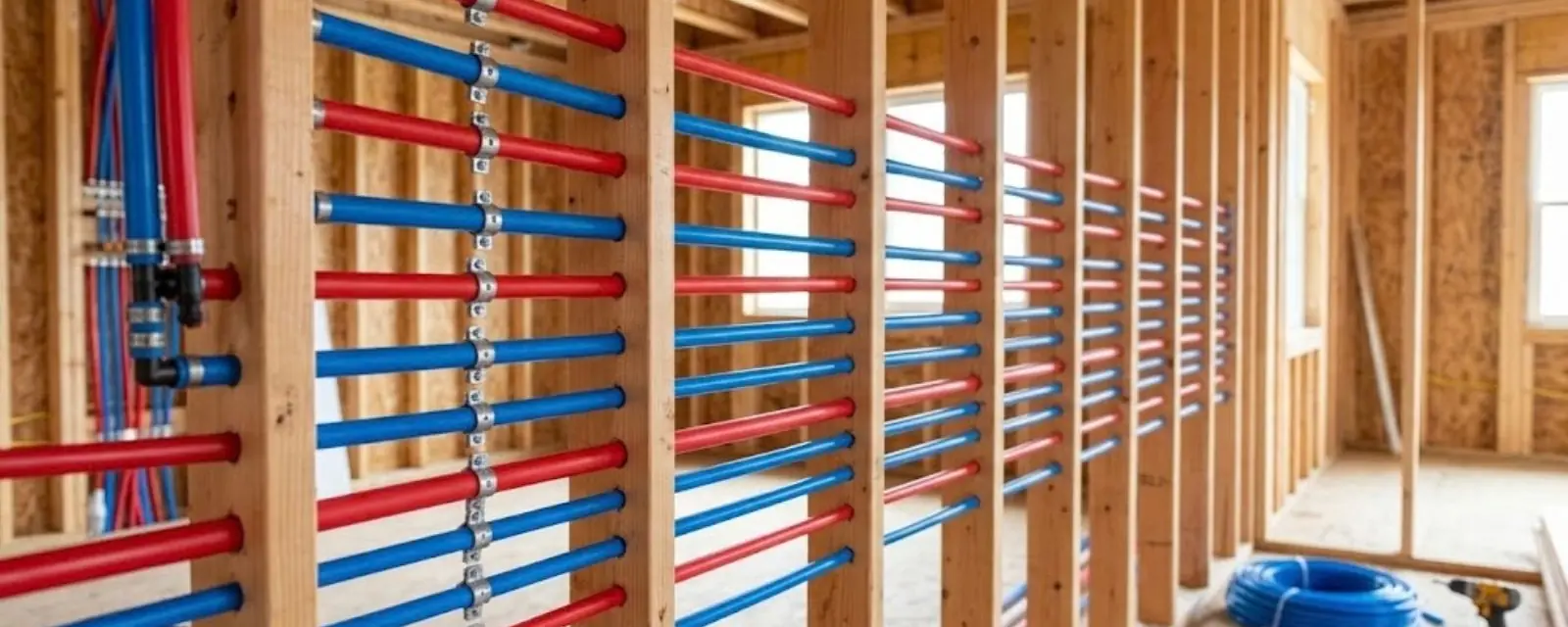
| PEX | Flexible plastic, red, blue or white, with crimped or clamped fittings | Common in newer work, fewer joints, tolerates cold better than rigid pipe |
| CPVC | Cream or light yellow rigid plastic, solvent-welded joints | Can turn brittle with age and crack at fittings |
Identification is a starting point. A plumber should confirm the material before you decide anything.
Not sure what is in your walls?
Describe the pipes you can see in the basement or by the water heater, and we will help you work out what is there.
Repair, or repipe? A practical checklist
These points decide most cases.
- Number of leaks.
Several leaks in different places point toward replacement. A single leak at a joint usually points to a repair.
- Pipe material.
If your home has galvanized or polybutylene, replacement is the common recommendation. Copper, PEX and CPVC need case-by-case judgment.
- Water quality at the tap.
Persistent brown or rusty water, not related to utility work, can mean pipe corrosion.
- Pressure and flow.
Weak flow at every fixture, with the regulator and main valve checked, suggests narrowed pipe.
- Plans for the house.
A remodel that already opens walls is the cheapest time to replace what is hidden.
- Your budget and timeline.
Replacing the worst run now and the rest later is a legitimate plan when the pipes are failing unevenly.
Copper or PEX?
Copper has decades of track record, tolerates heat well and does not degrade in sunlight. It also costs more in material and labor, and it can suffer pinholes and freeze splits.
PEX is flexible, runs in long continuous lengths with fewer joints, and handles a hard freeze better than rigid pipe, though it can still split and it should stay out of sunlight. Fittings are its weak point, so workmanship counts.
Both are accepted choices. We recommend by the house: what is under the basement ceiling, how many bends the route has and what the owner prefers. We pick materials that meet the St. Louis County Plumbing Code as adopted by the city.
Basement and crawlspace homes: a repipe that mostly stays out of the walls
Most Wildwood houses have a basement or crawlspace, and that helps a repipe. Supply lines often run through the joists, so we can replace most of the system from below with limited drywall removal. Upstairs bathrooms and kitchens usually need a small number of access holes.
A house without a basement may need to route through the attic or a slab, which adds time and cost. We explain the route before work begins and show where openings will go.
How a repipe is carried out
- 1
Survey the system.
We trace every supply line, note the material and mark each fixture, so the new layout is planned before anything is cut.
- 2
Plan the route.
We decide where new lines will run, how many access holes are needed and which rooms lose water at what time.
- 3
Shut down and install.
The water is shut off in phases. New pipe goes in and connects to each fixture, the water heater and the main.
- 4
Test under pressure.
We fill the system, hold pressure and watch every joint before any wall is closed.
- 5
Close up and inspect.
Access holes are patched to a paint-ready state, and we coordinate any required inspection.
Permits for repiping in Wildwood
The City of Wildwood's building permit page lists new or replaced plumbing among work that needs a building permit. St. Louis County reviews, issues and inspects the plumbing permit, and the city adds zoning authorization. Plumbing falls under the St. Louis County Plumbing Code, adopted by the city.
Permit rules vary by project, so ask the building department what your job needs. You can also verify any plumber's license with St. Louis County's Board of Plumbing Examiners in the Department of Transportation and Public Works.
What affects the price of repiping
Repiping is priced to the house, not the square footage alone. You get a clear price before work starts.
Each bath, kitchen, laundry hookup and outdoor spigot adds pipe and connections.
Copper costs more than PEX in materials and labor, and the finish quality differs.
An open basement ceiling is faster than finished walls, a slab or a tight crawlspace.
A single branch is a fraction of a whole-house job, and phasing the work can spread the cost.
Drywall patching, painting and flooring are separate from plumbing and may need another trade.
Insurance generally treats a planned repipe as maintenance. If a pipe bursts and floods the home, the water damage may be covered, but the cost of replacing worn pipe often is not. Your policy decides.
For a repipe quote based on your actual pipe, call us and describe the leaks you have had.
Next steps and nearby repairs
If your problem is one failed section, a burst pipe repair may be all you need. If the water is not leaving the pipe but rising in cost, a leak detection visit will separate a repiping case from a single leak. We serve Ballwin and the rest of western St. Louis County for the same work.
Questions we hear in Wildwood, MO
Probably not, if it was built in the 1980s or 1990s and has no pattern of leaks. Most homes here are younger than the classic repiping candidates. Repeat leaks, rusty water or a known galvanized or polybutylene line change that.
Look at exposed supply pipe near the water heater or main. Galvanized is dull gray, has threaded joints and often rust stains. A magnet sticks to steel but not to copper. If you see it, have a plumber confirm.
It is a gray, blue or black flexible plastic pipe, sometimes marked PB. Some homes built in the late twentieth century had it, and many do not. If your home has it, ask a plumber for an inspection and a replacement plan.
Neither is best everywhere. PEX has fewer joints and handles cold better, while copper lasts a long time and resists sunlight. We recommend by the house, the route and your preferences.
It depends on the size of the house and access. Water is shut off in phases, and we explain the schedule and which fixtures are off when before we start.
The city's permit page lists new or replaced plumbing as needing a building permit, which St. Louis County reviews, issues and inspects. Rules vary, so ask the building department. We can explain what your job involves.
Maybe not. A repeat leak at one joint may be a bad fitting or poor workmanship. Several leaks on a single run of worn pipe is a stronger sign. We inspect first and tell you which it is.
Have a question this page did not answer? Call (855) 575-2890 at any hour and a dispatcher will talk it through.